
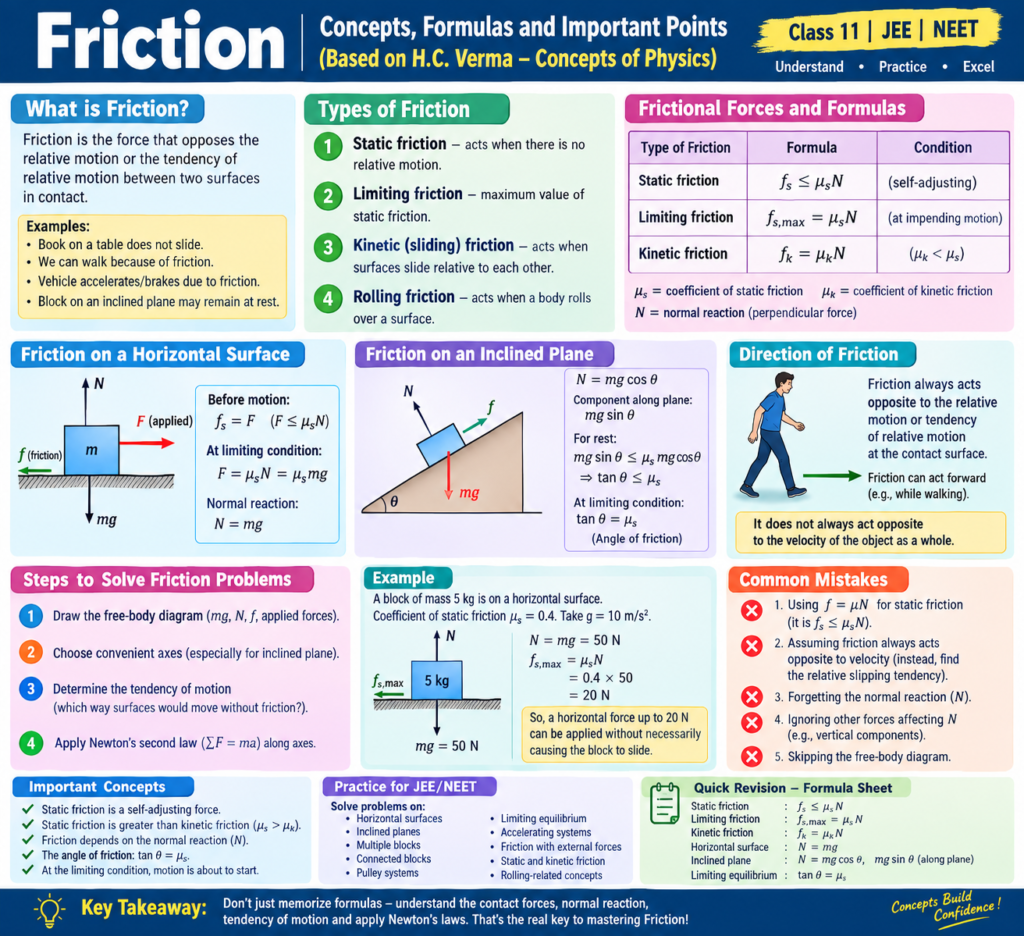
Friction – Complete Physics Guide for JEE and NEET Students
Friction is one of the most important topics in mechanics for Class 11 Physics, JEE Main, JEE Advanced and NEET. It explains the force that opposes the relative motion or tendency of relative motion between two surfaces in contact.
A strong understanding of friction is essential for solving problems involving blocks, inclined planes, pulleys, rolling objects and connected bodies.
What Is Friction?
When two surfaces are in contact, a force may develop along their common surface that opposes relative motion or the tendency of relative motion.
This force is called frictional force.
For example:
- A book placed on a table does not slide when the table is slightly tilted.
- We can walk because friction acts between our feet and the ground.
- A vehicle can accelerate and brake because of friction between the tyres and road.
- A block on an inclined plane may remain at rest because of friction.
Types of Friction
Friction can mainly be classified as:
- Static friction
- Limiting friction
- Kinetic or sliding friction
- Rolling friction
1. Static Friction
Static friction acts when there is no relative motion between the contacting surfaces.
Suppose a block is placed on a horizontal surface and a horizontal force is applied to it. If the block does not move, static friction balances the applied force.
Static friction is a self-adjusting force.
The maximum value of static friction is called limiting friction.
2. Limiting Friction
When the applied force is increased until the block is just about to move, static friction reaches its maximum value.
where:
- = coefficient of static friction
- = normal reaction
The coefficient of friction is dimensionless.
3. Kinetic Friction
Once the surfaces start sliding relative to each other, friction is called kinetic friction or sliding friction.
For many elementary problems:
where is the coefficient of kinetic friction.
Usually,
Therefore, the force required to start sliding an object is generally greater than the force required to keep it sliding.
Friction on a Horizontal Surface
Consider a block of mass resting on a horizontal surface.
The vertical forces are:
If a horizontal force is applied, friction acts opposite to the tendency of motion.
Before the block starts moving:
provided that
At the limiting condition:
Therefore,
This is the minimum horizontal force required to initiate motion in this simple situation.
Friction on an Inclined Plane
Consider a block of mass on an inclined plane making an angle with the horizontal.
The weight can be resolved into two components:
along the plane, and
perpendicular to the plane.
Therefore,
The maximum static friction is:
The component of weight trying to move the block down the plane is:
For the block to remain at rest:
or
At the angle of impending motion:
This angle is often called the angle of friction in elementary mechanics.
Important Concept: Friction Is Not Always
One of the most common mistakes students make is writing:
for every friction problem.
For static friction, this is not generally correct.
The correct relation is:
For example, if the maximum possible static friction is 20 N but the applied force trying to move the block is only 8 N, then:
not 20 N.
Static friction takes whatever value is necessary to prevent relative motion, up to its maximum value.
Direction of Friction
Friction always acts opposite to the relative motion or tendency of relative motion between surfaces.
This does not necessarily mean that friction always acts opposite to the velocity of the object as a whole.
For example, when a person walks forward, friction from the ground on the person’s foot can act forward. This friction helps the person accelerate.
Therefore, always determine the tendency of slipping at the contact surface before assigning the direction of friction.
Friction and Newton’s Laws
Friction problems are usually solved using Newton’s laws.
A good procedure is:
Step 1: Draw the free-body diagram
Show:
- Weight
- Normal reaction
- Applied forces
- Frictional force
Step 2: Choose convenient axes
For an inclined plane, it is usually convenient to choose:
- one axis parallel to the plane
- another axis perpendicular to the plane
Step 3: Determine the tendency of motion
Ask:
Which way would the surfaces move relative to each other if friction were absent?
Friction acts opposite to this tendency.
Step 4: Apply Newton’s second law
Apply it separately along the selected axes.
Example
A block of mass is placed on a horizontal surface. The coefficient of static friction is . Take .
The normal reaction is:
Maximum static friction:
Therefore, a horizontal force up to 20 N can be applied without necessarily causing the block to slide.
This illustrates why static friction is a self-adjusting force.
Common Mistakes in Friction Problems
Mistake 1: Always using
For static friction, use:
and use equality only at the limiting condition.
Mistake 2: Assuming friction always acts opposite velocity
Instead, determine the relative slipping tendency at the contact.
Mistake 3: Forgetting the normal reaction
The frictional force depends on the normal reaction:
when the appropriate limiting/kinetic condition applies.
Mistake 4: Ignoring other forces affecting
If an additional force has a vertical component, the normal reaction may not simply be .
Mistake 5: Skipping the free-body diagram
Many difficult-looking friction questions become much easier after drawing a correct free-body diagram.
Friction and JEE/NEET Preparation
For competitive examinations, students should practice friction problems involving:
- Horizontal surfaces
- Inclined planes
- Multiple blocks
- Connected blocks
- Pulley systems
- Limiting equilibrium
- Accelerating systems
- Friction with external forces
- Static and kinetic friction
- Rolling-related concepts
The most important skill is not memorizing formulas but identifying the correct direction and magnitude of friction.
Quick Revision Formula Sheet
Static friction
Limiting friction
Kinetic friction
Horizontal surface
Inclined plane
is the component of weight along the plane.
Condition for limiting equilibrium on an incline
Conclusion
Friction is a fundamental chapter of mechanics and an important topic for Class 11 Physics, JEE Main, JEE Advanced and NEET. The key to mastering it is understanding the difference between static friction, limiting friction and kinetic friction, followed by systematic free-body diagrams and Newton’s laws.
Students studying friction through H.C. Verma’s Concepts of Physics should focus particularly on conceptual questions and progressively harder numerical problems. Instead of memorizing every formula, develop the habit of identifying the contact forces, normal reaction, tendency of motion and appropriate friction condition.
A strong command of friction also provides a foundation for more advanced mechanics problems involving inclined planes, pulleys, connected bodies and rotational motion.
OBJECTIVE 1
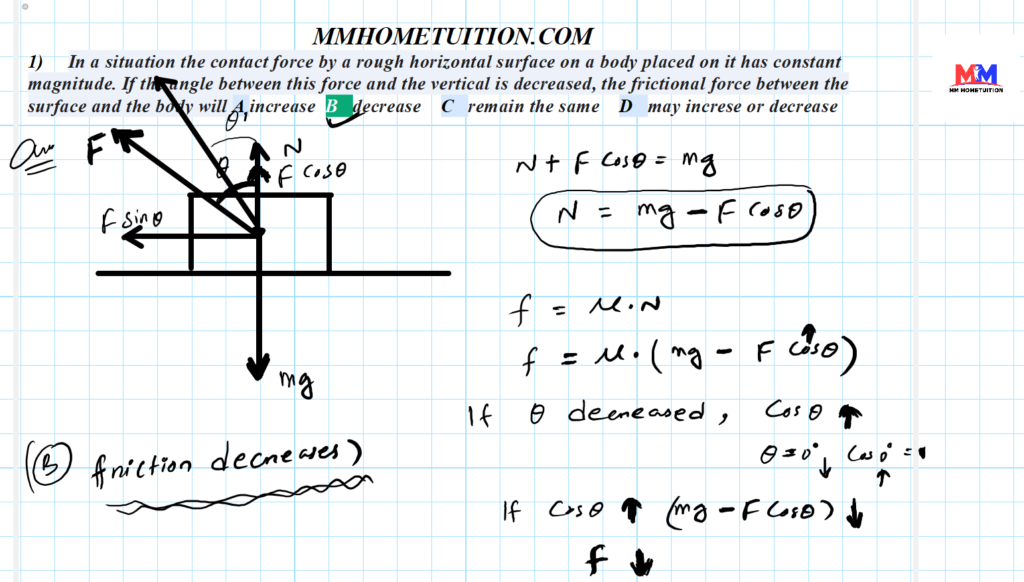
1)In a situation the contact force by a rough horizontal surface on a body placed on it has constant magnitude. If the angle between this force and the vertical is decreased, the frictional force between the surface and the body will A increase B decrease C remain the same D may increase or decrease
Ans) B decrease N+F cosθ = mg , N= mg – F cosθ , f(friction) = μN ,
f (friction) = μ(mg – F cosθ) , As θ decreases , F cosθ increases ,so f(friction) decreases .
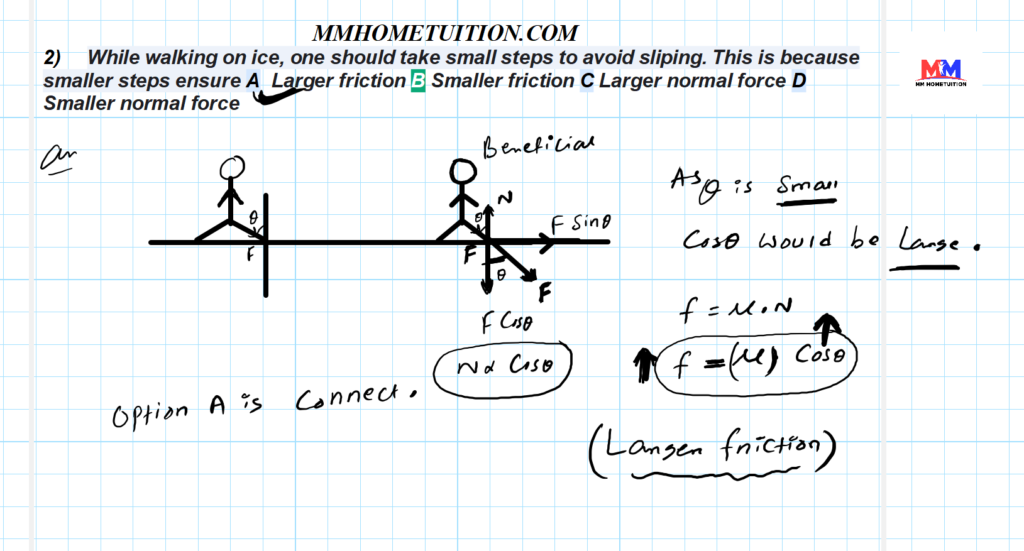
2)While walking on ice, one should take small steps to avoid sliping. This is because smaller steps ensure A Larger friction B Smaller friction C Larger normal force D Smaller normal force
Ans) A Larger friction Let θ be the angle between force and vertical , for small step θ is small , its vertical component cosθ would be larger , Hence friction varies directly to normal reaction , so friction varies directly to cosθ , Hence friction would be maximum .
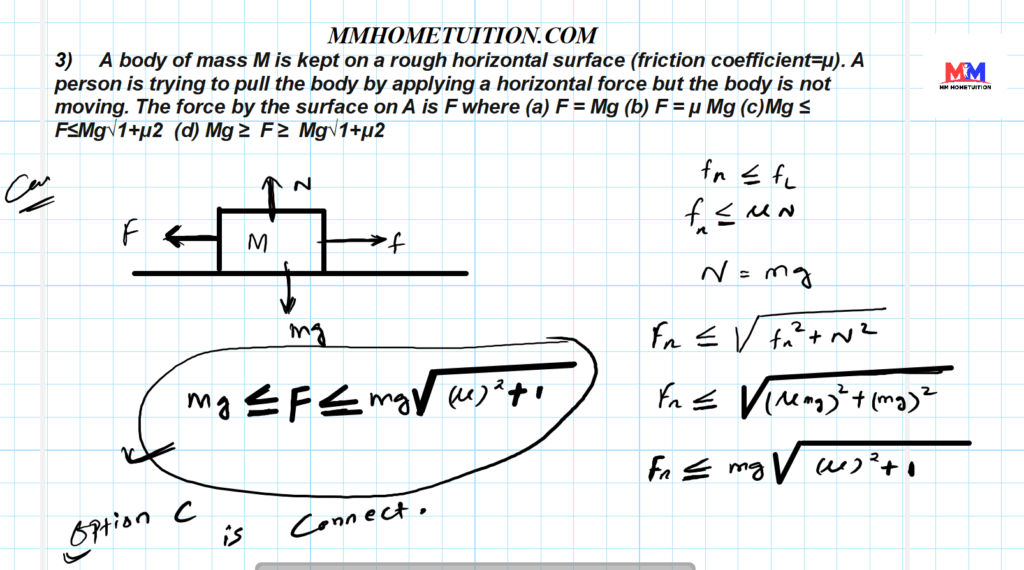
3)A body of mass M is kept on a rough horizontal surface (friction coefficient=µ). A person is trying to pull the body by applying a horizontal force but the body is not moving. The force by the surface on A is F where (a) F = Mg (b) F = µ Mg (c)Mg ≤ F≤Mg√1+μ2 (d) Mg ≥ F ≥ Mg√1+μ2
Ans)option c (c)Mg ≤ F≤Mg√1+μ2 is correct
applied force = frictional force ,
Normal reaction = weight =mg ,
frictional force ≤ μ N , frictional force ≤ μ N,
frictional force ≤ μ mg ,
F= √f2 + N2 = √(μmg)2 + (mg)2 = mg√1+μ2
Mg ≤ F≤Mg√1+μ2 is correct
4)A scooter starting from rest moves with as constant acceleration for a time Δt1 , then with a constant velocity for the next Δt2 and finally with a constant deceleration for the next Δt3 to come to rest. A 500N man sitting on the scooter behind the driver manages to stay at rest with respect to the scooter without touching any other part. The force exerted by the seat on the man is A 500 N throughout the journey B less than 500 N throughout the journey C more than 500 N throughtout the journey D >500 N for time Δt1 and Δt3 and 500N for Δt2
Ans) D >500 N for time Δt1 and Δt3 and 500N for Δt2 , Due to pseudo force net force is greater than 500 N for time Δt1 and Δt3 , as pseudo force is absent in case of constant velocity Hence it is 500 N for Δt2
5)Consider the situation shown in figure (6-Q1). The wall is smooth but the surfaces of A and B in contact are rough. The friction on B due to A in equilibrium a)is upward b) is downward c) is zero d)the system cannot remain in equilibrium
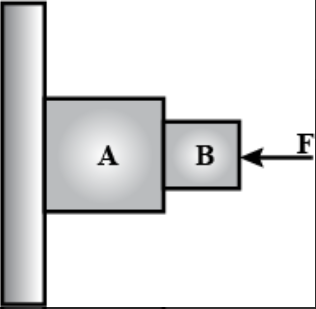
Ans) d the system cannot remain in equilibrium , as wall is smooth there is no friction between wall and block A , Hence the system cannot remain in equilibrium
6)Suppose all the surfaces in the previous problem are rough. The direction of friction on B due to A A is upward B is downward C is zero D depends on the masses of A and B
Ans) A is upward , friction force is directed upward
7)Two cars of unequal masses use similar tyres. If they are moving at the same initial speed, the minimum stopping distance A is smaller for the heavier car B is smaller for the lighter car C is same for both the cars D depends on the volume of the car
Ans) C is same for both the cars , V2 – U2 = 2a S , S= U2/2a , acceleration = F/m = μmg/m = μg ,
S(min stopping distance ) = U2/2 μg , S(min stopping distance ) is independent of mass . so min stopping distance is same for both the cars .
8)In order to stop a car in shortest distance on a horizontal road, one should apply the brakes very hard so that the wheels stop rotating apply the brakes hard enough to just prevent slipping pump the brakes (press and release) shut the engine off and not apply brakes
Ans) b) apply the brakes hard enough to just prevent slipping , friction would be enough to prevent slipping
9)A block A kept on an inclined surface just begins to slide if the inclination is . The block is replaced by another block B and it is found that it just begins to slide if the inclination is A mass of A > mass of B B mass of A < mass of B C mass of A=mass of B D all the three are possible.
Ans) D all the three are possible. f(friction) = mg sinθ , μN = mg sinθ , N = mg cosθ , μ mg cosθ = mg sinθ ,
μ= tan θ , a= g(sin θ – μcosθ) , acceleration is independent of masses
Hence all the three are possible
10)A boy of mass M is applying a horizontal force to slide a box of mass M on a rough horizontal surface. The coefficient of friction between the shoes of the boy and the floor is μ and that between the box and the floor is μ’. In which of the following cases it is certainly not possible to slide the box? A μ<μ’ , M<M’ B μ > μ’ , M<M’ C μ < μ’ , M>M’ D μ > μ’ , M>M’
Ans) A μ<μ’ , M<M’ is correct , not possible to slide the box then box is heavier or the coefficient of friction between the box and the floor would be maximum ,
OBJECTIVE 2
1)Let F,Fn,f denote the magnitudes of the contact force, normal force and the friction exerted by one surface on the other kept in contact. If none of these is zero, a)F>Fn b)F>f c)Fn>f d)Fn-f <F<Fn+f
Ans) a, b , d are right F(resultant force ) between normal force and friction is greater than normal force , F(resultant force ) between normal force and friction is greater than frictional force , also it lies between Fn-f <F<Fn+f
2) The contact force exerted by a body A on another body B is equal to the normal force between the bodies. We concude that A the surface must be frictionless B the force of friction between the bodies is zero C the magnitude of normal force equals that of friction D the bodies may be rough but they don’t slip on each other.
Ans) option b and option d are correct
3) Mark the correct statements about the friction between two bodies –
(a) static friction is always greater than the kinetic friction
(b) coefficient of static friction is always greater than the coefficient of kinetic friction
(c ) limiting friction is always greater than the kinetic friction
( d) limiting friction is never less than static friction
Ans) option b,c,d are correct
4) A block is placed on a rough floor and a horizontal force F is applied on it. The force of friction f by the floor on the block is measured for different values of F and a graph is plotted between them. a) The graph is a straight line of slope 45 b) The graph is straight line parallel to the F axis c) The graph is a straight line of slope 45 for small F and a straight line parallel to the F-axis for large F.
Ans) option c and d are correct
5) Consider a vehicle going on a horizontal road towards east. Neglect any force by the air. The frictional forces on the vehicle by the road A is towards east if the vehicle is accelerationg B is zero if the vehicle is moving with a uniform velocvity C must be towards east D must be towards west
Ans) option a and option b both are correct During forward motion frictional force is in the same direction
EXERCISES
1)A body slipping on a rough horizontal plane moves with a deceleration of .4 m/s2 . What is cofficient of kineic friction between the block and the plane?
Ans) F= ma = μN , ma = μmg , a= μg , μ= a/g , μ= 4/10 = 0.4
Coefficient of kinetic friction between the block and plane is unitless and dimensionless .
2)A block placed on a rough horizontal surface is imparted a velocity of 10 m/s. the coefficient of kinetic friction between the block and the surface is 0.5 and g=10 m/s2 . How much distance the block will cover, before coming to rest?
Ans)ma = μmg , a = μg ,a = 0.5*10 = 5 m/s2
We know that v2 – u2 = 2 as , 02 – 10 2 = 2 *5*S , S = 100/10 = 10 meter
3)A block of mass m is kept on a horizontal table. If the static friction coefficient is µ, find the frictional force acting on the block.
Ans) f(frictional force ) = μN = μmg
4)A block slides down an inclined surface of inclination 30^∘ with the horizontal. Starting from rest it covers 8 m inhthe first two seconds. Find the coefficient of kinetic friction between the two
Ans) S= Ut + ½ at2 , a = g sinθ – μg cosθ , a = g(sinθ – μ cosθ ) , a = 10(sin 30° – μcos 30° ) , 4 = 10(1/2 – μ √3/2 ) , 0.4 = ½ – μ √3/2 , μ√3/2 = 0.1 , μ= 0.2/√3
S = Ut + ½ at2 , 8 = 0*t + ½ a (2)2 , a = 4 m/s2
5)Suppose the block of the previous problem is pushed down the incine witas force of 4N. How far will the block move in the first two seconds after starting from rest? The mass of the block is 4 kg.
Ans) a = gsinθ – μg cosθ in the previous problem ,
In this problem block moves in forward direction with a1= F/m = 4/4 = 1 m/s2
a = gsinθ+1 – μg cosθ = 10 sin 30 + 1 – 0.2/√3*10 *cos 30 = 6 – 1 = 5 m/s2
we know that S = Ut + ½ at2 , S = 0*t + ½ 5 (2) 2 , S = 10 metre
6)A body of mass 2 kg is lying on a rough inclined plane of inclination 30°. Find the magnitude of the force parallel to the incline needed to make the block move (a) up the incline (b) down the incline. Coefficient of static friction = 0.2.
Ans) a) During up the incline , Net force = mg sin 30° + μ mg cos 30 °
b) During down the incline , Net Force = mg sin 30° – μ mg cos 30 °
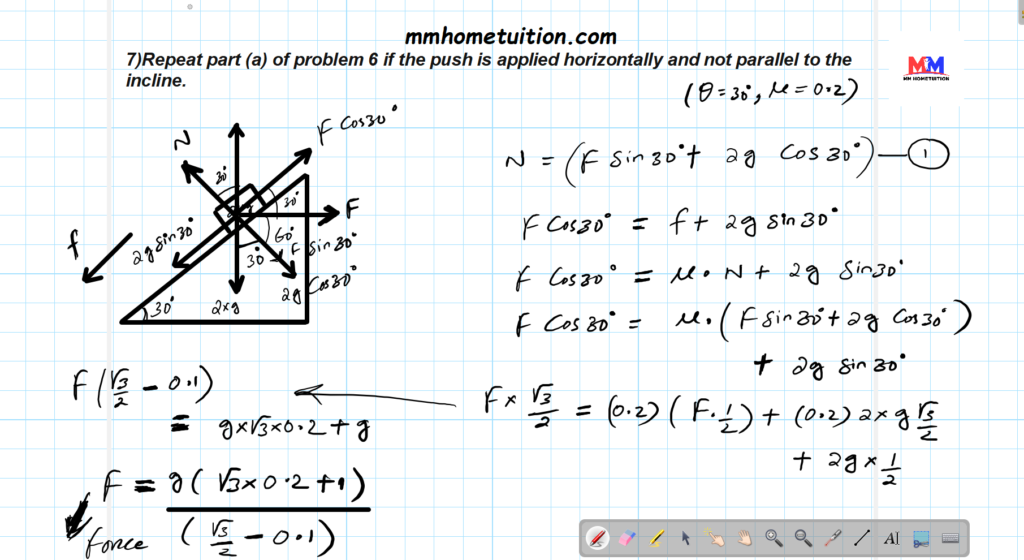
7)Repeat part (a) of problem 6 if the push is applied horizontally and not parallel to the incline.
8)In a children park an inclined plane is constructed with an angle of incline 45 ° in the middle part (figure 6-E1). Find the acceleration of a boy sliding on it if the friction coefficient between the cloth of the boy and the incline is 0.6 and g=10 m/s2 .
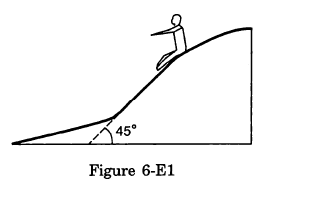
Ans) Net Downward force F= Mg sin 45° – μ Mg cos 45° ,
Ma = Mg sin 45° – μ Mg cos 45° ,
a(acceleration ) = g sin 45° – μg cos 45° ,
a(acceleration) = 10/√2 – 0.6*10*1/√2 , a = 4/√2 m/s2
9)A body starts slipping down an incline and moves half meter in half second. How ling will it take to move the next half meter?
Ans) S = Ut + ½ at2 , As body starts from rest U=0 , S = 1/2 at2 , ½ = ½ a (1/2)2 , a = 4 m/s2
From A to C S = Ut + ½ at2 , 1 = 0*t + ½ a t2 , 1 = ½ (4) t2 , tAc = 1/√2 sec = 0.707 sec
T ab = ½ sec = 0.5 sec , Tac = 0.707 sec , T bc = 0.707 – 0.5 = 0.207 sec
10)The angle between the resultant contact force and the normal force exerted by a body on the other is called the angle of friction. Show that if λ be the angle of friction and μ the coefficient of static friction, λ≤tan -1 μ
Ans) F = f ≤ μN , F/N ≤ μ , tan λ ≤ μ , λ ≤ tan -1 (μ)
11)Consider the situation shown in figure (6-E2). Calculate (a) the acceleration of the 1. 0 kg blocks, (b) the tension in the string connecting the 1. 0 kg blocks and (c) the tension in the string attached to 0. 50 kg
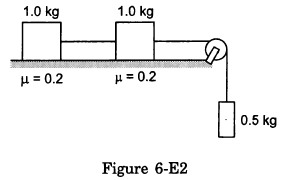
) writing equation for 1kg(left corner) ,
T’ – μ(1*g) = 1*a —-(1
T’ – 0.2(1*g)= 1*a —-(1
Writing equation for 1kg (right corner)
T – (T’ + μ(1*g) ) = 1*a —(2
T- (T’ + 0.2(1*g) ) = 1*a —(2
Writing equation for 0.5 kg
0.5*g – T = 0.5 *a —–(3
Adding equation 1,2,3 we get
0.5*g – 0.4g = 2.5 a ,
a = 0.1 *g /2.5 = 4 m/s2
- Acceleration of block 1kg = 4 m/s2
- Tension in the string T attached to 0.5kg = 0.5*g – 0.5*a = 0.5*(10 – 4) = 0.5*6= 3 Newton
- Tension in the string connecting to 1kg block
T’ – 0.2(1*g)= 1*a ,
T’ = 0.2(1*g) + 1*a ,
T’ = 0.2 * g + 1*a , T’= 0.2*10 + 1* 4 = 6 Newton
12)If the tension in the string in the figure. Is 16 N and the acceleration of each block is 0.5 m/s2 , find the friction coefficients at the two contacts with the blocks.
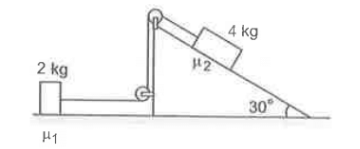
Ans) writing equation for 2 kg,
T – μ1*2*g = 2*a —-(1
16 – μ1*2*g = 2*0.5 —-(1
Writing equation for 4kg ,
4g sin30 – T-μ2*4*g*cos 30° = 4 *a —-(2
4*10*1/2 – 16 – μ2*4*g*√3/2 = 4*0.5 —(2
From equation 1 , μ1 = 0.75
From equation 2 , μ2 = 2/2√3g = 0.05
13)The friction coefficient between the table and the block shown in figure is 0.2. Find the tension in the two strings.
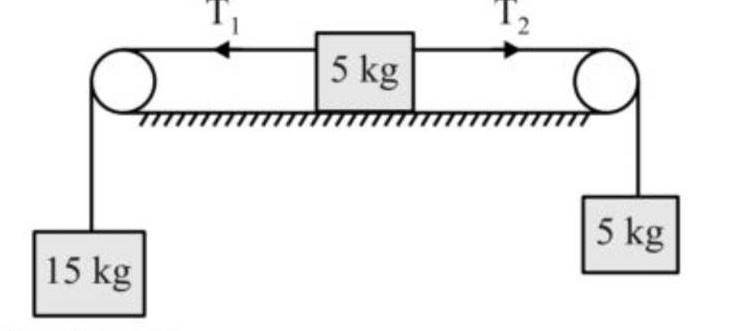
Ans) writing equation for 15kg ,
15*g – T1 = 15*a —-(1
Writing equation for 5kg
T1 – T2 = 5*a —-(2
Writing equation for 5kg
T2 – 5*g = 5*a —–(3
10*g = 25*a
a= 4 m/s2
T1 = 90 Newton
T2 = 70 Newton
14)The friction coefficient between a road and the tyre of a vehicle is 4/3. Find the maximum incline the road may have so that once hard brakes are applied and the wheel starts skidding, the vehicle going down at a speed of 36 km/hr is stopped within 5m.
Ans) V2 – U2 = 2 a S , V2 = U2 + 2 a S , 02 – 10 2 = 2 a S , 100 = 2*a*5 , a = 10 m/s2
N = mg cos θ —-(1
Mg sin θ – μ Mg cosθ = ma —-(2
θ=sin-1(7/25) = 16°
15)The friction coefficient between an athelete’s shoes nd the ground is 0.90. Suppose a superman wears these shoes and rces for 50 m. There is no upper limit n his capacity of running at high speeds. A. Find the minimum time tht he will have to take in completing the 50 m starting from rest. b. Suppose he takes exactly this minimum time to complete the 50 m, what minimum time will he take to stop?
Ans) fk = μN = m*a
0.90*m*g = m*a ,
a=9 m/s2
S = Ut + ½ at 2 ,
50 = ½ g t 2 , 100 = g t2 , t2 = 10 , t = √10 sec = 3.3 sec
For A to B , V = U + at , V= 0 , V = gt , V = 10*3.3 = 33 m/s
From B to C , V = U + at , 0 = 33 – 9*t , t = 33/9 = 11/3 sec
16)A car is going at a speed of 21.6 km/hr when it encounters a 12.8 m long slope of angle 30° ( figure 6-E5) .The friction coefficient between the road and the tyre is 1/2√3 . Show that no matter how hard the driver applies the brakes, the car will reach the bottom with a speed greater than 36 km/hr. Take g=10m/s2
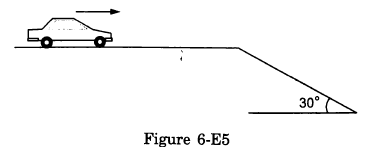
Ans) U= 21.6 km/hr = 21.6 * 5/18 = 6 m/s
S= 12.8 metre
a(acceleration ) = g sinθ – μg cos θ = 2.5 m/s2
Velocity at end of incline = V = √U2 + 2as , V = √6 2 + 2 *(2.5)* (12.8) = √100 = 10 m/s = 36 km/h
Therefore harder the driver applies brakes the lower will be the velocity of car when it reaches ground i.e at 36 km/hr
17) A car starts from rest on a half kilometer long bridge. The coefficient of friction between the tyre and the road is 1.0. Show that one cannot drive through the bridge in less than 10 s.
Ans) F= ma = μN = μ mg , a = μ g = 1* 10 = 10 m/s2
S = Ut + ½ at2 , as it starts from rest , U=0 , a= 10 m/s2
S = 500 meter , 500 = ½ (10) t2 , t2 = 100 , t = 10 sec
18)Figure (6-E6) shows two blocks in contact sliding down an inclined surface of inclination 30°. The friction coefficient between the block of mass 2. 0 kg and the incline is µ1, and that between the block of mass 4. 0 kg and the incline is µ2. Calculate the acceleration of the 2. 0 kg block if (a) µ1 = 0. 20 and µ2 = 0. 30, (b) µ1 = 0. 30 and µ2 = 0. 20. Take g = 10 m/s 2
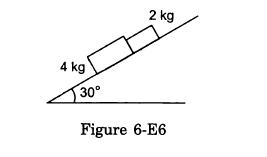
Ans) net force = (4g sin30° + 2g sin30°)-(μ1 4g cos 30° + μ2 2g cos 30° ) = (6g sin30°) – (0.20 *4g*cos 30° + 0.30 *2g* cos 30°)
F= ma = 3*10 – 6g cos30° * 0.50 = 30 – 25.95 = 4.05 newton
6*a = 4.05 , a = 4.05 / 6 = 0.675 m/s2
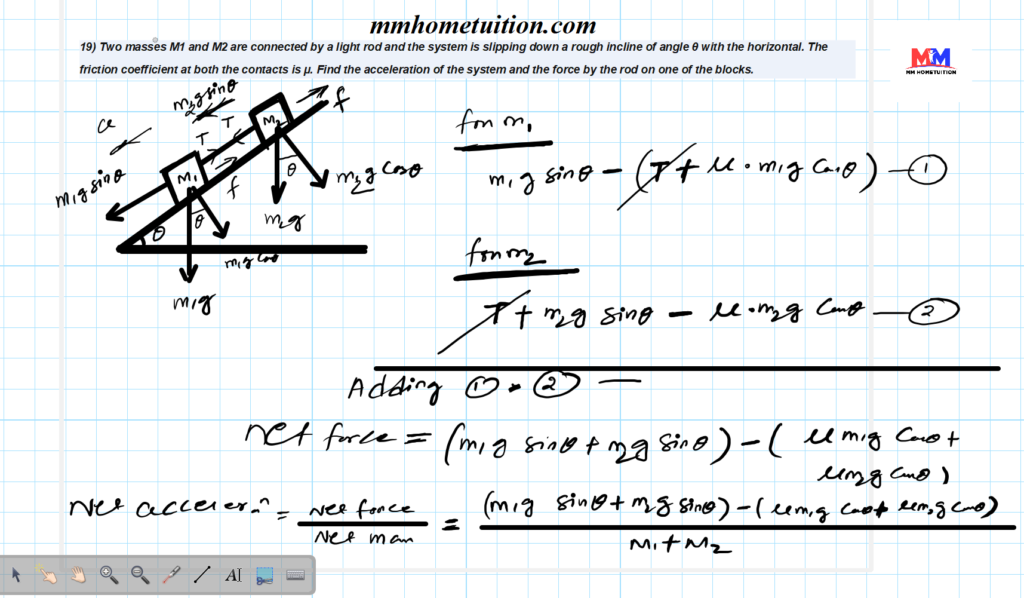
19)Two masses M1 and M2 are connected by a light rod and the system is slipping down a rough incline of angle θ with the horizontal. The friction coefficient at both the contacts is µ. Find the acceleration of the system and the force by the rod on one of the blocks.
Ans) N1 = m1 g cosθ , N2 = m2 g cos θ
Writing equation for M1 , M1g sinθ – T – μ M1*g * cosθ = M1 *a ——-(1
Writing equation for M2 , M2 g sinθ +T – μ M2*g*cosθ = M2*a ———(2
Adding equation 1 and 2 we get , acceleration (a) = M2 g sinθ+ M1g sinθ – (μM1g cosθ + μ M2g cosθ) / (M1+M2)
20)A block of mass M is kept on as rough horizontal surface. The coefficient of static friction between the block and the surface is μ . The block is to be pulled by applying a force to it. What minimum force is needed to slide the block? In which direction should this force act?
Ans) ⅀Fx = 0 , ⅀Fy = 0 ,
⅀Fx = 0, F cosθ = μ N ,
F cosθ = μ (mg – F sinθ) , F = μmg/cosθ + μ sinθ
⅀Fy = 0 , N + F sinθ = mg , N = mg – F sinθ
For F min , y= cosθ + μ sinθ = maximum ,
dy/dθ = 0 , – sinθ + μ cosθ = 0 , μ = tanθ
F = μmg/cosθ + μ sinθ =
Dividing cosθ on numerator and Denominator
F = μmg /cosθ / cosθ/cosθ + μ sinθ/cosθ =
F = μmg secθ / 1+μ tanθ = μmg secθ / 1+ tanθ tanθ
F = μ mg secθ / 1+ tan θ 2 = μmg secθ / secθ 2 =
F= μmg / secθ = μmg / √1+tanθ 2 = μmg / √(1+μ 2)
21)The friction coefficient between the board and the floor shown in figure is Find the maximum force that the man can exert on the rope so that the board does not slip on the floor
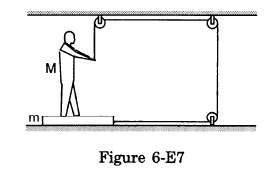
Ans) writing equation for the man ,
T+R= Mg —–(1
R= Mg – T ——(1
Writing equation for the block ,
Vertical equation mg +R = R1 ——(2
Horizontal equation T= μN = μ(R+R1) —-(3
Putting equation 1 and 2 in equation 3 we get ,
T= μ(Mg – T +mg+R)
T= μ(Mg – T + mg + Mg – T )
T= μ(2Mg-2T+mg)
T+2μT = 2μMg + μmg
T(1+2μ) = 2μMg + μmg
T = 2μMg + μmg/(1+2μ)
22)A 2 kg block is placed over a 4 kg block and both are placed on a smooth horizontal surfae. The coefficient of friction between the blocks is 0.20. Find the acceleration of the two blocks if a horizontal force of 12 N is applied to a. the upper block, b. the lower block. Take g=10m/s2
Ans) if horizontal force 12 N applied on upper block
- find common acceleration ac = Fnet/M+m = 12 / 6 = 2 m/s2
- find required value of friction on which force is not applied = M*ac = 4 *2 = 8 newton
- fmax = μN= 0.2*2*10 = 4 newton
Freq > Fmax , both moves with different acceleration
Acceleration for 2kg = 12- 0.2*2*10 / 2 = 4 m/s2
Acceleration for 4 kg = fmax/4*g = 4/40=0.1 m/s2
if horizontal force 12 N applied on lower block
- find common acceleration ac = Fnet/M+m = 12 / 6 = 2 m/s2
- find required value of friction on which force is not applied = m*ac = 2 *2 = 4 newton
- fmax = μN= 0.2*2*10 = 4 newton
- Freq ≤ fmax , both moves with common acceleration 2 m/s2
23)Find the accelerations a1,a2 ,a3 of the three blocks shown in figure(6-E8) if a horizontal force of 10 N is applied on a. 2 kg block, b. 3 kg block, c. 7 kg block. Take g=10m/s2
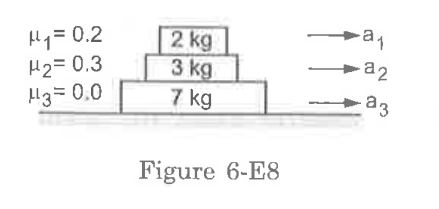
Ans) a)10 N applied on 2kg ,
10 – 0.2*2*g = 2*a1 ,
0.2*2*g – 0.3*5*g = 3*a2 ,
0.3*5*g = 7*a3 ,
b) 10 N applied on 3kg
10 – 0.3*5*g = 3*a2 ,
0.2*2*g = 2*a1,
0.3*5*g = 7*a3 ,
C) 10 N applied on 7kg ,
10 = 7*a3 ,
0.3*5*g= 3*a2 ,
0.2*2*g = 2*a1 ,
24)The friction coefficient between the two blocks shown in figure (6-E9) is µ but the floor is smooth. (a) What maximum horizontal force F can be applied without disturbing the equilibrium of the system ? (b) Suppose the horizontal force applied is double of that found in part (a). Find the accelerations of the two masses.
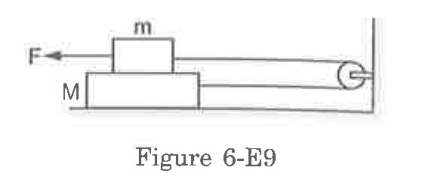
Ans) a) What maximum horizontal force F can be applied without disturbing the equilibrium of the system ?
Writing equation for m ,
F = μ*m*g + T —–(1
Writing equation for M ,
f=μmg = T —-(2
putting equation 2 in equation 1 , we get
F max = μmg + μmg = 2μmg
(b) Suppose the horizontal force applied is double of that found in part (a). Find the accelerations of the two masses.
Writing equation for m,
2F-T-μmg = m*a ——(1
Writing equation for M ,
T – (f=μ*m*g)= M*a ——-(2
Putting equation 2 in equation 1 we get
2F – μ*m*g-Ma – μ*m*g = m*a
2F- 2*μ*m*g /(M+m) = a
2*2μmg – μ*2*m*g /(M+m) = a
2μmg/(M+m)= a (acceleration )
25) Suppose the entire system of the previous question is kept inside an elevator which is coming down with an acceleration a<g. Repeat parts a. and b.
Ans)1) R+ma = mg , R = m(g-a) , f=μm(g-a)
F= T+fs = T+μm(g-a) = μm(g-a)+ μm(g-a)= 2 μm(g-a)
T=fs= μm(g-a)
2) 2F – (T+fk) = a(m) —-(1
T-fk = Ma ———(2
Solving 1 and 2 we get , 2F – 2fk = a(M+m)
2*2 μm(g-a) – 2* μm(g-a) = a(M+m)
2* μm(g-a)/( M+m) = a(acceleration)
26) Consider the situation shown in figure. Suppose a small electric field E exists in the space in the vertically upward direction and the upper block carries a positive charge Q on its top surface. The friction coefficient between the two blocks is μ but the floor is smooth. what maximum horizontal force F can be applied without disturbing the equilibrium?
27)A block of mass m slips on a rough horizontal table under the action of horizontal force applied to it. The coefficient of friction between the block and the table is μ . The table does not move on the floor. Find the total frictional force applied by the floor on the legs of the table. Do you need the friction coefficient between the table and the floor or the mass of the table ?
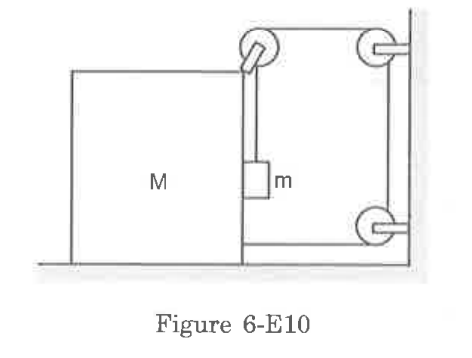
28)Find the acceleration of the block of mass M in the situation of figure (6-E10). The coefficient of friction between the two blocks is μ1 and that between the bigger block and the ground is μ2 .
29)A block of mass 2kg is pushed against a rough vertical wall with a force of 40N, coefficient of static friction being 0.5. Another horizontal force of 15 N, is applied on the block in direction parallel to the wall. Will the block move? If yes, in which direction? If no, find the frictional force exerted by the wall on the block.
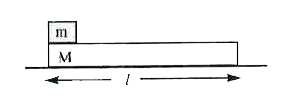
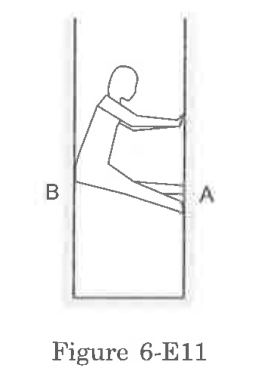
30)A person (40 kg) is managing to be at rest between two vertical walls by pressing one wall A by hi hands and feet and the other wall B by his back figure. Assume that the friction coefficient between his body and the walls is 0.8 and that limiting friction acts at all the contacts. a. show that the person pushes the two walls with equal force. b. find the normal force exerted by either wall on the person Take g=10m/s2
31)Figure shows a small block of ‘m’ kept at the left end of larger block of mass ‘M’ and length ‘l’. The system can slide on a horizontal road. The system is started towards right with an initial velocity ‘u’ The friction coefficient between the road and bigger block is and that between the block is μ/2.Find the time elapsed before the smaller block separates from bigger block is