

What Is Kinematics?
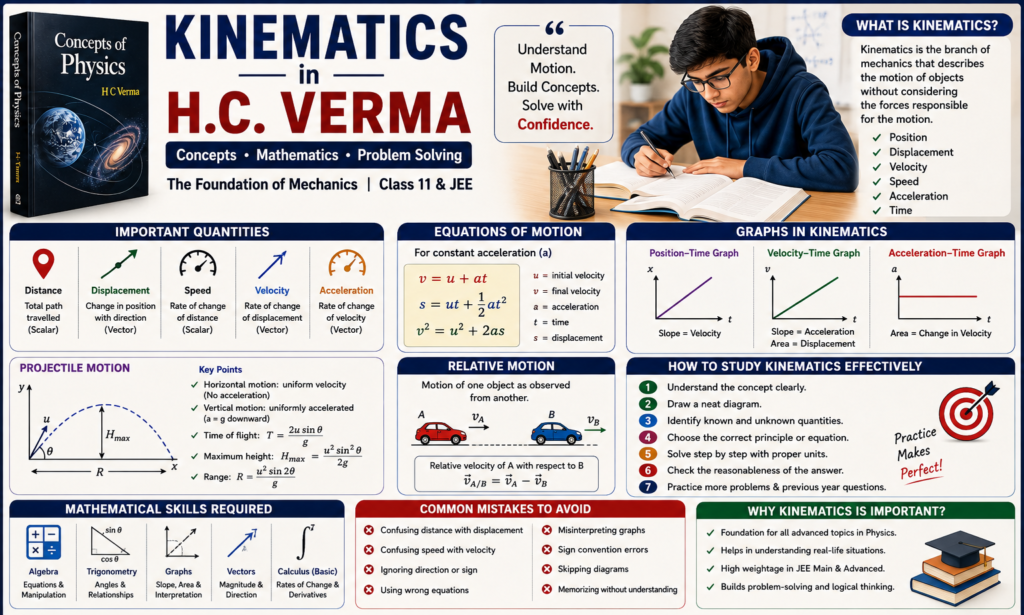
Kinematics is the branch of mechanics concerned with describing the motion of objects.
The major quantities studied in kinematics include:
- Position
- Distance
- Displacement
- Speed
- Velocity
- Acceleration
- Time
A student should understand the difference between these quantities before attempting advanced numerical problems.
Distance and Displacement
Distance describes the total path travelled by an object and is a scalar quantity.
Displacement describes the change in position and has both magnitude and direction, making it a vector quantity.
For example, if a student walks around a track and returns to the starting point, the distance travelled may be significant, while the final displacement is zero.
This distinction becomes important in many conceptual questions.
Speed and Velocity
Speed represents how quickly an object covers distance, whereas velocity describes the rate of change of displacement.
Average speed can be expressed as:
Average Speed = Total Distance / Total Time
Average velocity is:
Average Velocity = Displacement / Total Time
Students should pay attention to whether a problem asks for distance or displacement because choosing the wrong quantity can lead to an incorrect answer.
Acceleration
Acceleration describes the rate at which velocity changes with time.
For constant acceleration, the familiar equations are:
v = u + at
s = ut + ½at²
v² = u² + 2as
where:
- u = initial velocity
- v = final velocity
- a = acceleration
- t = time
- s = displacement
However, students should not simply memorize these equations. It is more important to understand the conditions under which they can be used.
Graphs in Kinematics
Graphs are an important part of kinematics and are frequently used to test conceptual understanding.
Position-Time Graph
The slope of a position-time graph represents velocity.
Velocity-Time Graph
The slope of a velocity-time graph represents acceleration.
The area under a velocity-time graph represents displacement.
Understanding these relationships allows students to solve many problems without relying entirely on formulas.
Mathematical Skills Required for Kinematics
A good mathematical foundation makes kinematics considerably easier.
Students should be comfortable with:
Algebra
Rearranging equations and solving for unknown quantities is essential for numerical problems.
Graphs
Students should learn how to interpret slopes, areas and changes in graphical quantities.
Vectors
Velocity and displacement can have direction, so vector concepts are important.
Basic Calculus
For advanced physics preparation, students can benefit from understanding the relationship:
Velocity = Rate of change of displacement
and
Acceleration = Rate of change of velocity
This mathematical perspective becomes increasingly useful in higher-level physics.
Projectile Motion
Projectile motion is another important application of kinematics.
When an object is projected at an angle, its motion can be analyzed by resolving the initial velocity into horizontal and vertical components.
The horizontal and vertical motions can then be studied separately.
Important concepts include:
- Horizontal velocity
- Vertical velocity
- Time of flight
- Maximum height
- Horizontal range
- Angle of projection
Understanding vectors and trigonometry is particularly helpful for projectile-motion problems.
Relative Motion
Relative motion deals with the motion of one object as observed from another moving or stationary reference frame.
For two objects A and B, the velocity of A relative to B can be represented as:
v₍A/B₎ = v₍A₎ − v₍B₎
Relative velocity becomes useful in problems involving moving vehicles, boats, rain and other objects.
How to Study Kinematics from H.C. Verma
Students can follow a systematic approach.
1. Understand the Concept
Read the theory carefully and make sure the physical meaning of each quantity is clear.
2. Draw a Diagram
For many motion problems, a simple diagram can make the situation easier to understand.
3. Identify Known Quantities
Write down the given values and determine exactly what the question asks.
4. Select the Appropriate Principle
Do not immediately substitute numbers into a formula. First determine which physical relationship applies.
5. Solve Step by Step
Keep units consistent and check the direction or sign of vector quantities.
6. Analyze the Answer
Ask whether the result is physically reasonable.
OBJECTIVE 1
1)A motor car is going due north at a speed of 50 km/h . it makes a 90 degree left turn with out changing the speed . The change in the velocity of car is about a) 50 km/h towards west b) 70 km/h towards south- west c) 70 km/h towards towards north-west d) zero
ANS _ resultant = √(50)2 + (50)2 = 50√2 directed along south-west direction
2)Figure (3-Q2) shows displacement- time graph of a particle moving on the X- axis .a) the particle is continuously going in positive x direction(b) the particle is at rest (c) the velocity increases up to a time t0, and then becomes constant (d) the particle moves at a constant velocity up to a time t0, and then stop
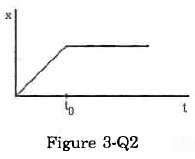
ANS : up to t0 it moves with constant velocity and after t0 it will be at rest
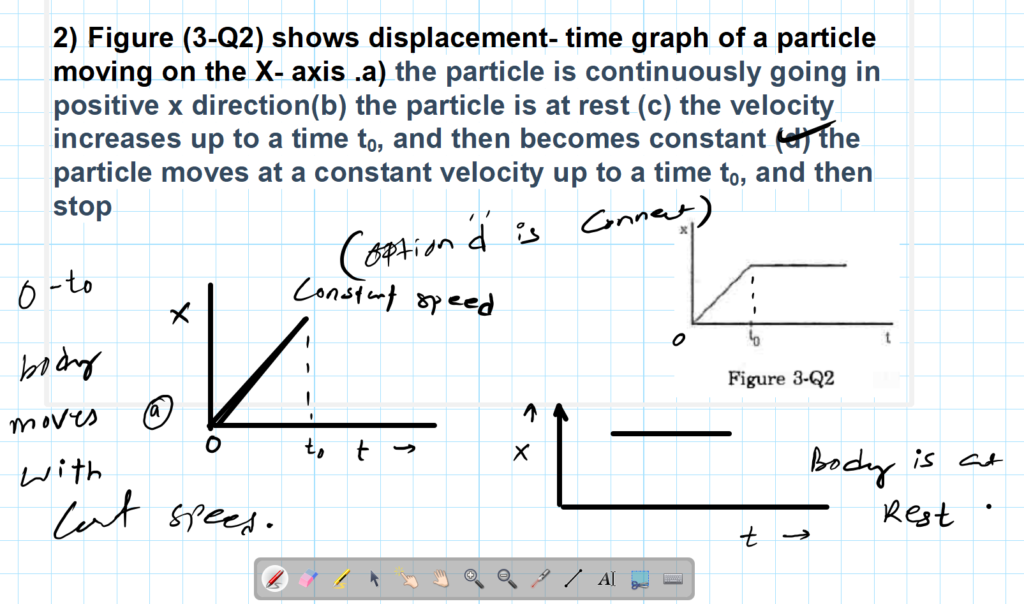
3)A particle has a velocity u towards east at t = 0. Its acceleration is towards west and is constant. Let xA and xB be the magnitude of displacements in the first 10 seconds and the next 10 seconds (a) xA < xB (b) xA=XB (C) XA>XB (d) the information is insufficient to decide the relation of xA with xB
ANS : there may be two scenario with in one XA > XB in another XA=XB , Hence the information is insufficient to decide the relation of XA with XB
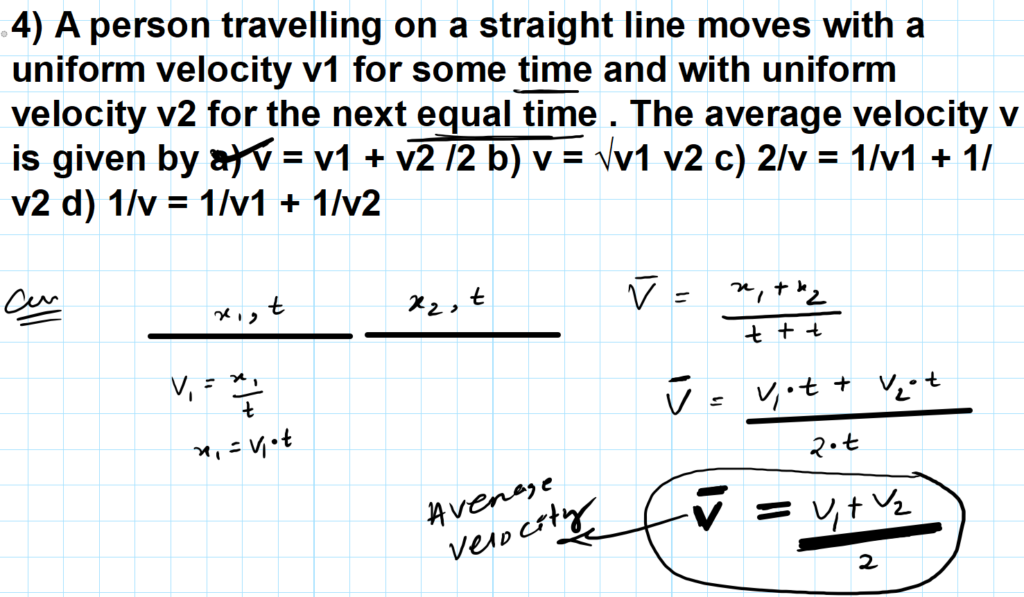
4)A person travelling on a straight line moves with a uniform velocity v1 for some time and with uniform velocity v2 for the next equal time . The average velocity v is given by a) v = v1 + v2 /2 b) v = √v1 v2 c) 2/v = 1/v1 + 1/v2 d) 1/v = 1/v1 + 1/v2
ANS : Let x1 be the distance covered for v1 speed and x2 be the distance covered for v2 speed
Average speed v = x1+ x2 / t1+t2 , v= v1.t + v2 . t / t + t = v1 + v2 / 2
5)A person travelling on a straight line moves with a uniform velocity v1 for a distance x and with a uniform velocity v2 for the next equal distance . The average velocity v is given by a) v = v1+ v2/2 b) v= √v1v2 c) 2/v = 1/v1 + 1/v2 d) 1/v = 1/v1 + 1/v2
ANS : Average Speed v = x1 + X2 / t1 + t2 = x+ x / x/v1 + x/v2 , 1/v1 + 1/v2 = 2/v
6)A stone is released from an elevator going up with an acceleration a . The acceleration of the stone after the release is a) a upward b)( g-a) upward c) (g-a) downward d) g downward
Ans : as stone falls under free fall case it falls with gravity (a=g)
7)A person standing near the edge of the top of a building throws two balls A and B. The ball A is thrown vertically upward and B is thrown vertically downward with the same speed. The ball A hits the ground with a speed vA and the ball B hits the ground with a speed vB. We have (a) vA > vB (b) vA < vB (c) vA = vB (d) the relation between vA and vB depends on height of the building above the ground.
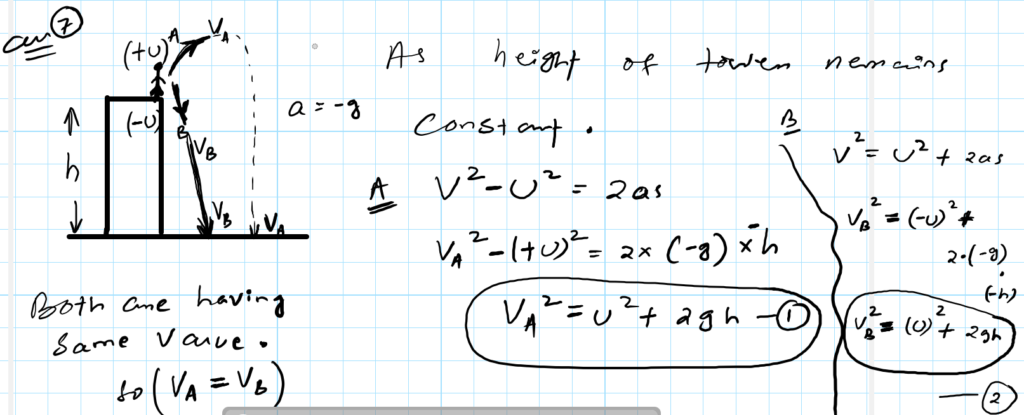
Ans : A is moving upward so initial speed u is positive B is moving downward so initial speed u is negative using sign convention . Va2 = ua2 + 2 (-g)(-h) , va2 = ua2 + 2gh , for B Vb2 = ub2 + 2(-g)(-h) , vb2 = ub2 + 2gh in both cases speed va equation is same as speed vb equation hence va = vb .
8)In a projectile motion the velocity a) is always perpendicular to the acceleration b) is never perpendicular to the acceleration c) is perpendicular to the acceleration for one instant only d) is perpendicular to the acceleration for two instants
Ans : at the highest point of projection velocity is perpendicular to the acceleration , it is possible at one instant only
9) Two bullets are fired simultaneously, horizontally and with different speeds from the same place. Whch bullet will hit the ground first? A) Slower one B) Faster one C) Both will reach simultaneously D) Cannot be predicted
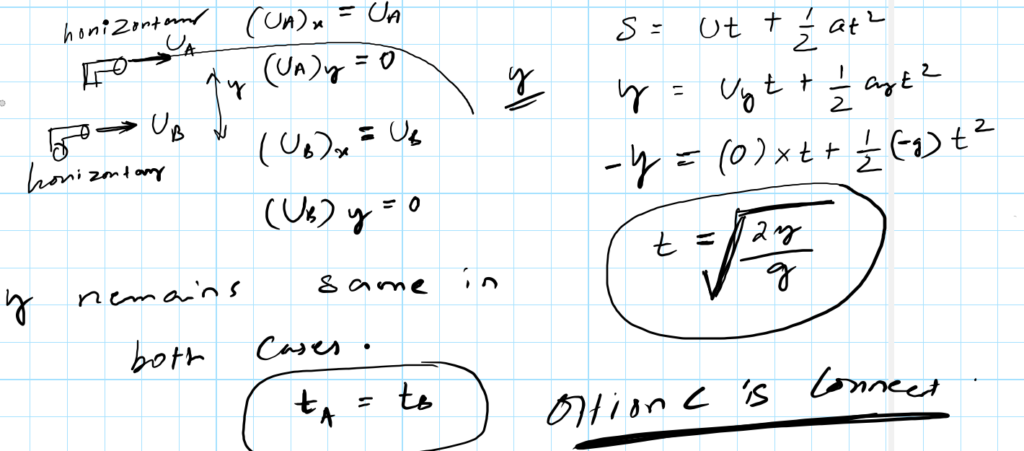
Ans : let ua be the initial speed of bullet A , ub be the initial spped of bullet B , horizontal speed of bullet a is Ua and its vertical component is zero . horizontal speed of bullet b is ub and its vertical component is zero . so using vertical equation y = uy .t + ½ (-g) t2 , as uy is zero y = ½ gt2 , t = √2y/g , as height of projection remains same in both cases then time to strike ground also remains same in both cases .
10)The range of a projectile fired at an angle of 15° is 50 m . if it is fired with the same speed at an angle of 45° , its range will be —– a) 25 m b) 37 m c) 50 m d) 100 m
Ans : R proportional sin 2θ
50 proportional sin 2(15 °) , 50 proportional sin 30° …..1
R proportional sin 2(45°) , R proportional sin 90° …….2
Dividing 1 and 2 R =100 m
11)Two projectiles A and B are projected with angle of projection 15° for the projectile A and 45° for the projectile B . if Ra and Rb be the horizontal range for the two projectile then a) Ra < Rb b) Ra = Rb c) Ra > Rb d) the information is insufficient to decide the relation of Ra with Rb .
Ans : R proportional sin 2θ ,but R = u2 sin 2θ/g , so R also depends upon u and angle θ , so u data is not given . hence data insufficient
12)A River is flowing from west to east at a speed of 5 metres per minute. A man on the south bank of the river , capable of swimming at 10 metres per minute in still water , wants to swim across the river in the shortest time . He should swim in a direction a) due north b) 30 ° east of north c) 30 ° north of west d) 60 ° east of north
Ans to have min time t = L/u cosθ , cos θ should be max so t is minimum , Hence θ is 0° , Hence man should drive along north direction
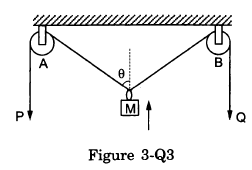
13)In the arrangement shown in figure(3-Q3), the ends p and q of an inextensible string move downwards with uniform speed u . Pulleys A and B are fixed. The mass M moves upwards with a speed a)2ucosθ b)u/cosθ c) 2u/cosθ d) ucosθ
Ans : v cosθ along AM = u , vcosθ = u , v = u/cos θ
OBJECTIVE 2
1)Consider the motion of the trip of the minute hand of a clock . In one hour a) The displacement is zero b) the distance covered is zero c) The average speed is zero d) the average velocity is zero
Ans : As min hand completes one rotation i.e for one hour = 60 min , displacement is zero average velocity is zero .
2)A particle moves along x axis as x = u(t-2) + a(t-2)2 a)The initial velocity of the particle is u b) the acceleration of the particle is a c) the acceleration of the particle is 2a d) at t=2s particle is at origin
Ans : x = u(t-2) + a(t-2)2 velocity v’ = dx/dt = u + 2a (t-2) , acceleration a’ = dv/dt = 2a at t= 2 sec x is zero so particle is at the origin ,
option c option d both are correct
3)Pick the correct statements :
(a) Average speed of a particle in a given time is never less than the magnitude of the average velocity.
(b) It is possible to have a situation in which |vector dv/dt| ≠ 0 but d/dt|vector v| = 0.
(c) The average velocity of a particle is zero in a time interval. It is possible that the instantaneous velocity is never zero in the interval.
(d) The average velocity of a particle moving on a straight line is zero in a time interval. It is possible that the instantaneous velocity is never zero in the interval. (Infinite accelerations are not allowed.)
Ans : A yes particle moves from a to b in st line path average velocity is less than particle moving from a to b in zig zag path (correct )
B when particle moves in circular path centripetal acceleration is never zero but change in velocity is zero when completes one rotation (correct)
C When particle moves in circular path for one complete rotation average velocity is zero but instantaneous velocity never be zero(correct )
D when body moves in a st line and returns to original position then average velocity is zero but instantaneous velocity is also zero at some instant (wrong)
4)An object may have
(a)Varying speed without having varying velocity
(b)Varying velocity without having varying speed
(c)Non zero acceleration without having varying velocity
(d)Non zero acceleration without having varying speed.
Ans : A when body moves in circular path option b ans d satisfies the condition like uniform circular motion where speed is constant but velocity changes at each instant , acceleration is also non –zero with constant speed circular motion
5)Mark the correct statements for a particle going on a straight line: A)If the velocity and acceleration have opposite sign, the object is slowing down.B) If the position and velocity have opposite sign, the particle is moving towards the origin. C)If the velocity is Zero at an instant, then acceleration should also be zero at that instasnt. D) If the velocity is zero for a time interval, the acceleration is zero at any instant within the time interval.
Ans : A ) yes velocity and acceleration have opposite sign object is slowing down
B) Yes position and velocity have opposite sign then object is slowing down
C) No this is not correct
D ) yes if the velocity is zero for a certail time interval then acceleration is also zero at any instant because body remains at rest though out the time interval
6)The velocity of a particle is zero at t=0 A) The accelerationat t=0 must be zero B) the acceleration at t=0 maybet zero C) the acceleratin is zero from t=0 to t=10 s, the speed is also zero in this interval. D If the speed is zero from t=0 to t=10 s the acceleration is also zero in this interval.
Ans : A) this is not correct bcoz must is there
B) this is correct yes possibility is there
C) this is correct
D) this is correct
7)Mark the correct statement. A The magnitude of the velocity fo a particle is equal to it’s speed. B The magnitude of average velocity in an anterval is equal to it’s average speed in that interval. C It is possible to have a situation in which the speed of a particle is always zero but the average speed in not zero. D It is possible to have a situation in which the speed of the particle is never zero but the average speed an interval is zero.
Ans ) A this is correct as particle covers shortest distance then magnitude of velocity is equals to its speed
B wrong
C wrong
DWrong
8)The velocity time plot for a particle moving on straight line is shown in the figure.
A The particle has a constant acceleration B The particle has never turned around C The particle has zero displacement. D The average speed in the interval 0 to 10 s is the same as the average speed in the interval 10 s to 20s.
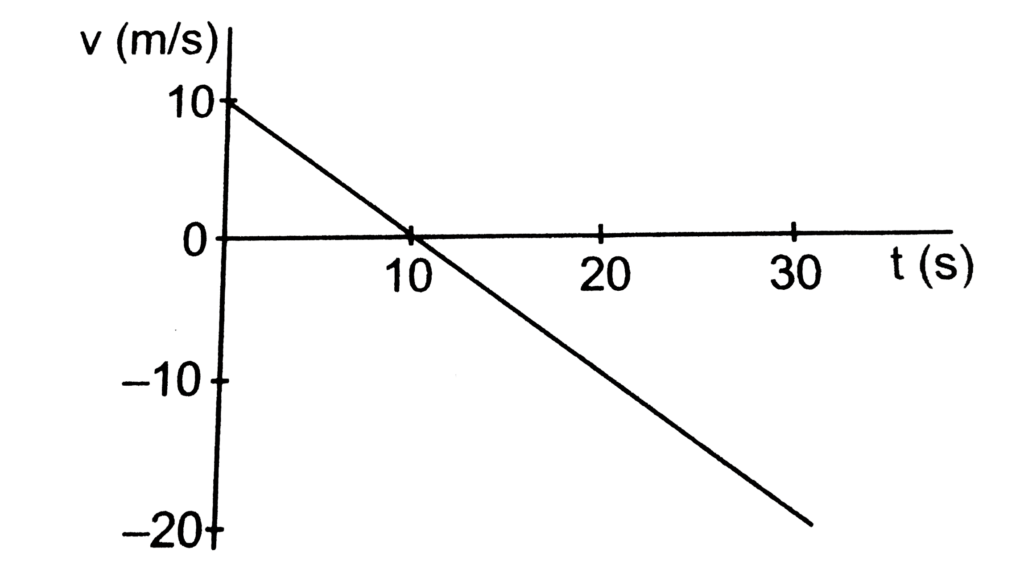
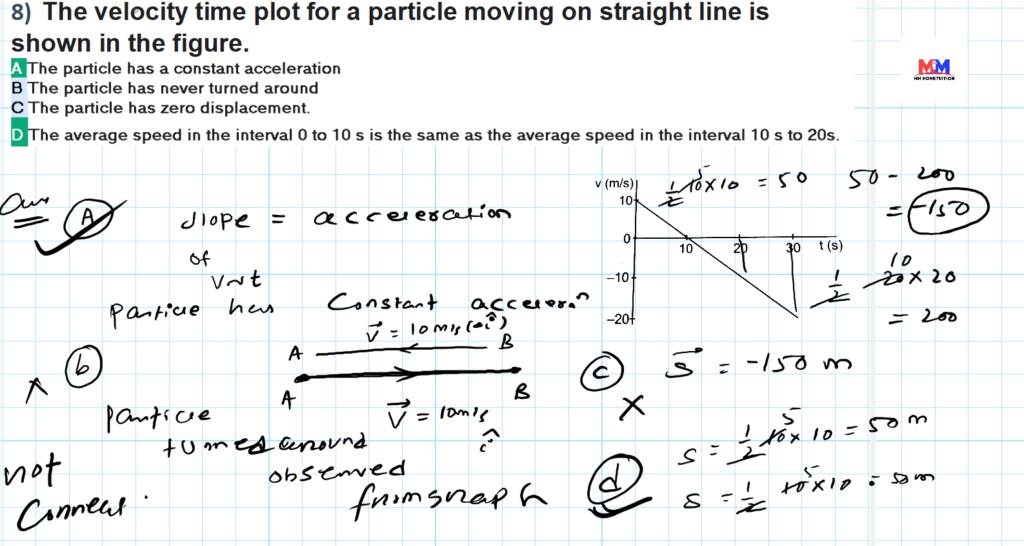
Ans)A yes particle has constant acceleration from the slope of the graph
B wrong
C wrong
D Area under (v-t)graph gives rise to displacement so displacement from 0 to 10 sec is same as displacement from 10 to 20 sec
9)Figure shows the position of a particle moving on the X-axis as a function of time.
A The particle has come to rest 6 times B The maximum speed is at t=6 s. C The velocity remains positive for t=0 to t=6s. D The average velocity for the total period shown is negative
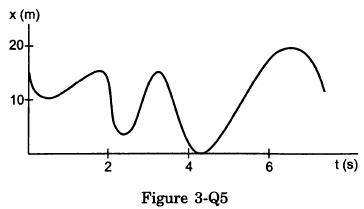
Ans ) A yes particle has comes to rest 6 times observed from graph as slope is zero
B) no this is not correct
C) as there are curves are there velocity remains positive as displacement is coming zero from t=0 to t = 6 sec
D) Average velocity for the total period is negative it is also not correct
10) The accleration of a particle as seen from two frames and have equal magnitudes 4m/s2 A the frames must be at rest with respect to each other B the frames may be moving with respect to each other but neither should be acclerated with respect to the other C the accleration of s2 with respect to s1 of may be either zero or 8 m/s2 . D the acceleration of s2 with respect to s1 may have any value between zero and 8 m/s2
Ans :
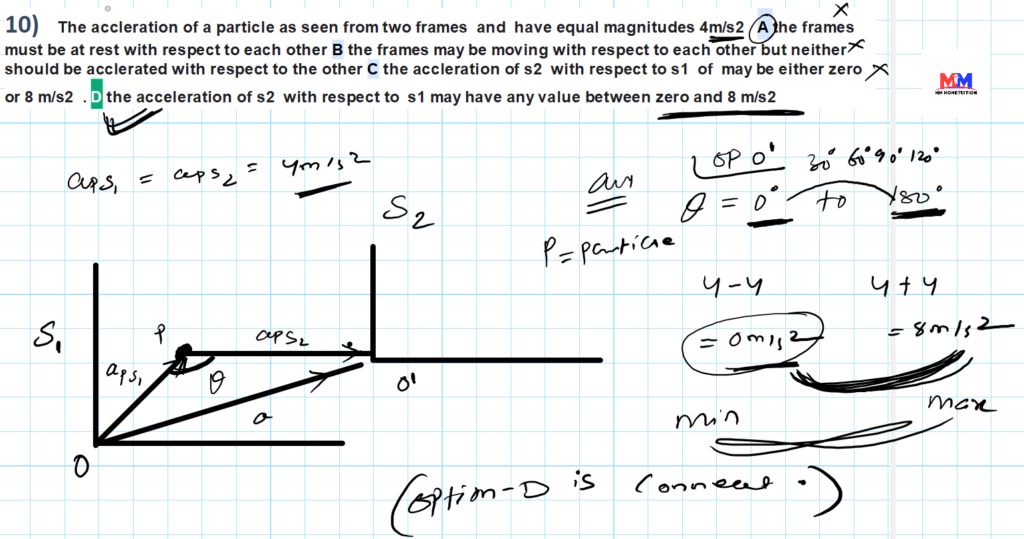
ANS ) aps1 = aps2 = 4 m/s2 so it depends upon θ value
θ value varies between 0° to 180 ° , so min acceleration is 4-4 = 0 m/s2 and maximum 4 + 4 = 8 m/s2 , acceleration value changes from min 0 m/s2 to max 8 m/s2 , Hence option d is correct .
EXERCISE
1)A man has to go 50 m due north , 40 m due east and 20 m due south to reach a field a) what distance he has to walk to reach the field ? b) what is his displacement from his house to the field ?
Ans ) a) total distance = 50 + 40 + 20 = 110 m b) Displacement = √302+ 40 2 = 50m
2)A particle starts from the origin ,goes along the X-axis to the point (20m,0) and then returns along the same line to the point (-20m,0 ) . Find the distance and displacement of the particle during the trip?
Ans ) Distance = 20 m + 20 m + 20 m = 60 m , Displacement = 20 –(Î) m
3) It is 260 km from patna to ranchi by air and 320 km by road . An aero plane takes 30 minutes to go from patna to ranchi where as a delux bus takes 8 hours . a) Find the average speed of the plane b)Find average speed of the bus c) Find average velocity of the plane d) find average velocity of the bus
Ans )a) average speed of the plane = 260/1/2= 520 km/hr, b)Average speed of the bus 320/8= 40 km/hr c) Average velocity of plane = 260 /1/2 = 520 km/hr d) Average velocity of bus = 260/8 = 32.5 km/hr
4) when a person leaves his home for sightseeing by his car ,the meter reads 12352 km . When he returns home after two hours the reading is 12416 km . a) what is the average speed of the car during this period ? b) what is the average velocity ?
Ans) a) average speed = 64km/2 hr = 32 km/hr
Average velocity = displacement / time = 0 km/hr
5) An athelete takes 2 sec to reach his maximum speed of 18 km/h . what is the magnitude of his average acceleration ?
Ans) max speed 18 km/hr = 18 * 5/18 = 5 m/sec , time 2 sec , average acceleration = 5/2 = 2.5 m/s2
6) The speed of a car as a function of time is shown in figure (3-E1) . Find the distance travelled by the car in 8 seconds and its acceleration

Ans ) Distance = area under graph = ½(8*20) = 80 m Acceleration = slope = 20/8 = 2.5 m/s2
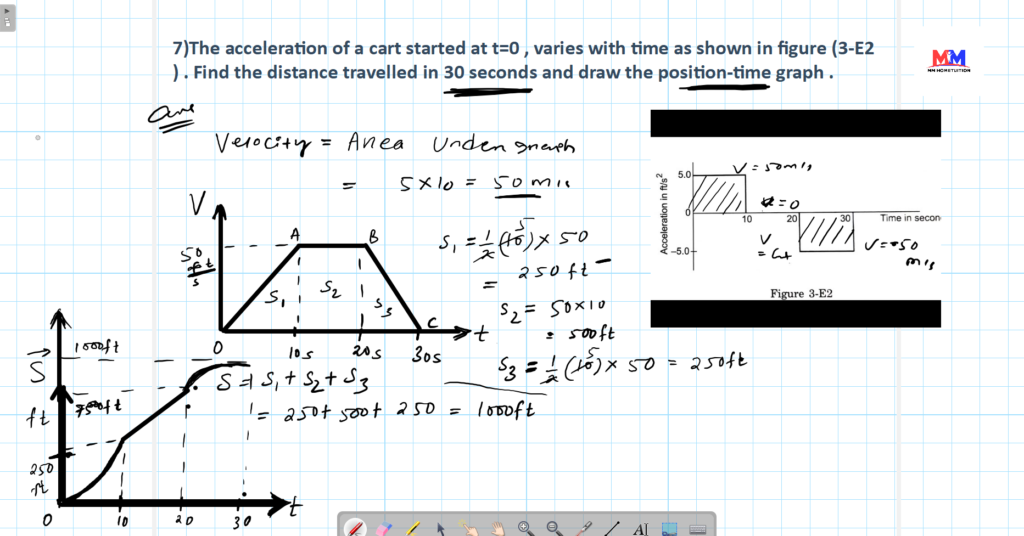
7)The acceleration of a cart started at t=0 , varies with time as shown in figure (3-E2 ) . Find the distance travelled in 30 seconds and draw the position-time graph .
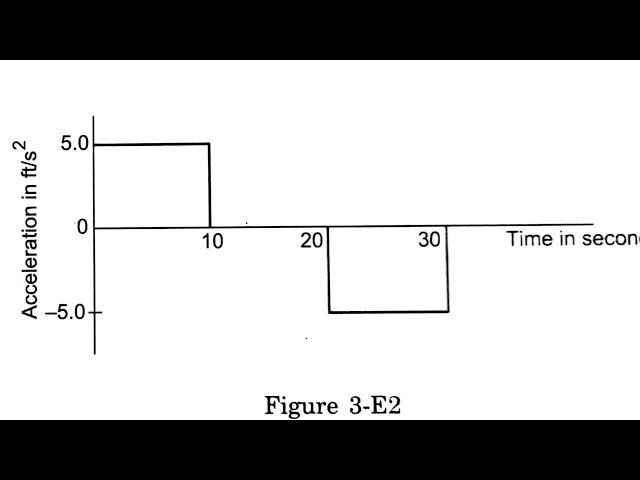
Ans : distance travelled s1 = 250 ft s2 = 500 ft s3 = 250ft total distance = 250 ft + 500ft+ 250 ft = 1000 ft
8) Figure (3-E3) shows the graph of a velocity versus time for a particle going along the X axis Find a) the acceleration b)the distance travelled in 0 to 10 sec and c) the displacement in 0 to 10 sec .
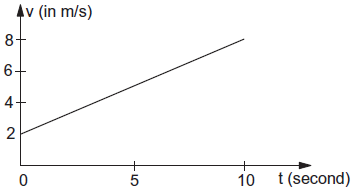
Ans)a) acceleration = slope = 6/10 = 0.6 m/s2 b) distance travelled = ½ (sum of parallel side )(perpendicular distance) = ½(2+8)(10)= 50 metre c) displacement = 50 metre
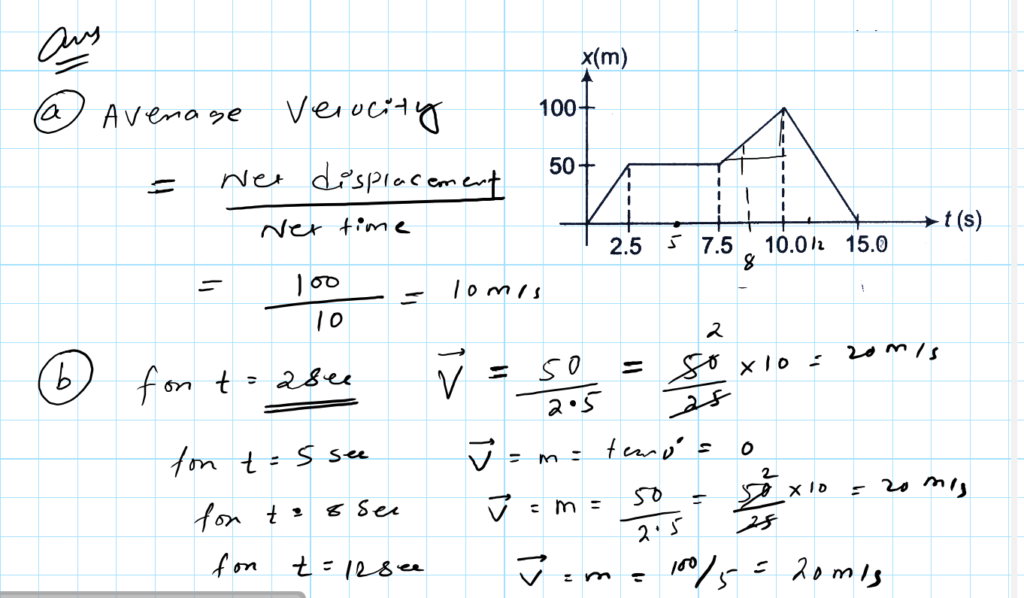
9)Figure(3-E4) shows the graph of the x-coordinate of a particle going along X-axis as a function of time Find a) the average velocity during 0 to 10 sec b) instantaneous velocity at 2,5,8,12 sec .
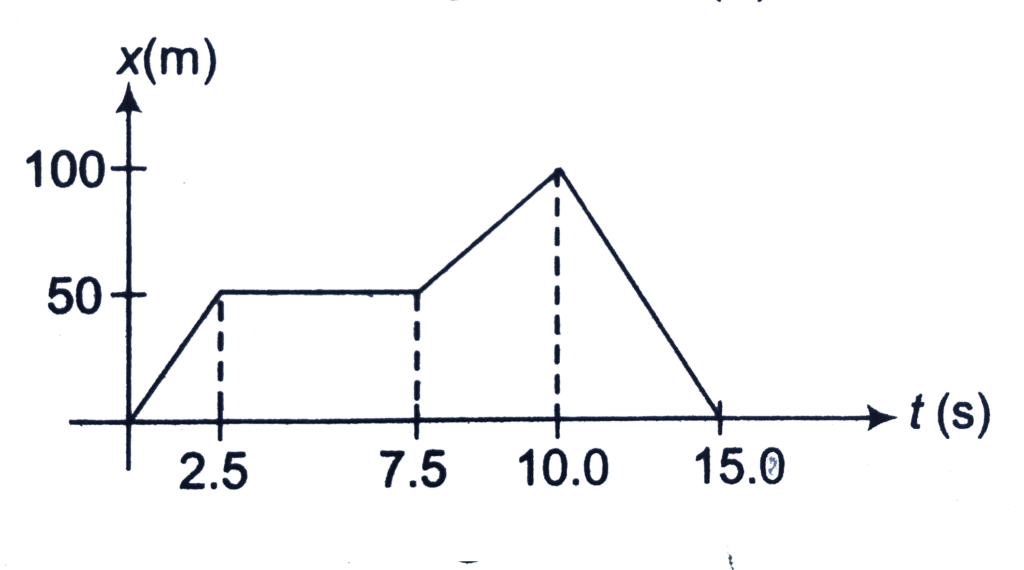
Ans :Average velocity = displacement /time = 100 / 10 = 10 m/s , instantaneous velocity for t= 2 sec 50/2.5 = 20 m/s , for t= 5 sec m = tan 0 = 0 , for t= 8 sec 50/2.5 = 20 m/s , for t= 12 sec 100/5 = 20 m/sec
10) From the velocity-time plot shown in figure (3-E5 ) ,find the distance travelled by the particle during the first 40 seconds . Also find the average velocity during this period .
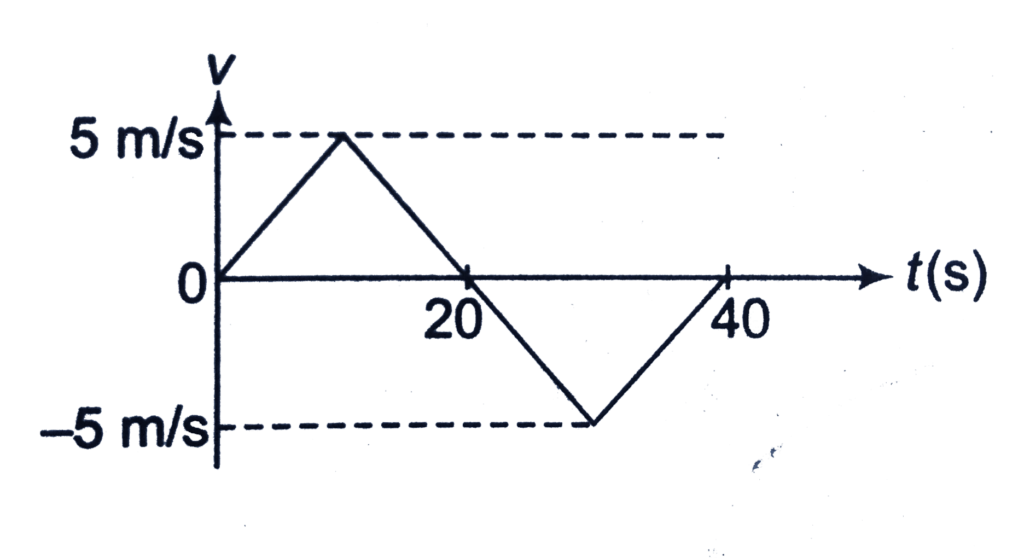
Ans : Distance travelled = area under graph = ½ (20)(5)= 50 m
Distance travelled = ½ (20)(5) = 50 m
Net distance = 50 + 50 = 100 metre
Average velocity = net displacement / net time = zero
11) Figure (3-E6 ) shows x-t graph of a particle . find the time t such that average velocity of the particle during the period 0 to t is zero.
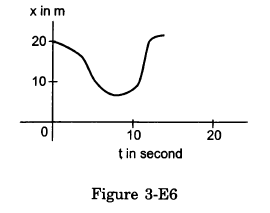
Ans: time at which average velocity will be zero i.e around 12 sec because at 12 sec net displacement is zero so average velocity is also zero .
12)A particle starts from a point A and travels along the solid curve shown in figure (3-E7) . Find approximately the position B of the particle such that the average velocity between the positions A and B has the same direction as the instantaneous velocity at B .
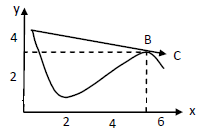
Ans ) at (5,3) metre average velocity between A and B has same direction as the instantaneous velocity at B
13)An object having a velocity 4 m/s is accelerated at the rate of 1.2 m/s2 for 5 s . Find the distance travelled during the period of acceleration ?
Ans ) s = ut + ½ at2 = 4*5 + ½ (1.2)(5)2 = 20 + 15 = 35 metre
14)A person travelling at 43.2 km/h applies the brake giving a deceleration of 6m/s2 to his scooter . How far will it travel before stopping ?
Ans ) u = 43.2 * 5/18 = 12 m/s , a = – 6 m/s2 , V2 – U2 = 2as , s = 02- 12 2 / 2 * 6 = 144 / 12 = 12 metre
15)A train starts from rest and moves with a constant acceleration of 2.0 m/s2 for half a minute. The brakes are then applied and the train comes to rest in one minute. Find a. the total distance moved by the train, b. the maximum speed attained by the train and c. the position(s) of the train at half the maximum speed.
Ans : a) u = 0 a= 2 m/s2 t= 30 sec V = U + at , V = 2 * 30 = 60 m/s
S = Ut + ½ at2 = 0*t + ½ 2 * (30)2= 900 m
b) Brakes applied train comes to rest in one minute
V= U + at , 0 = 60 + a * 60 , a= -1m/s2
V2 – U2 = 2 a s , S= Ut + ½ aT2 = 60* 60 + ½ (-2)(60)2 = 3600 –
02 – 602 = 2 *(-1) S , S = 3600 / 2 = 1800 m
Total distance = 900 m + 1800 m = 2700 m
c) half the max speed , 60 / 2 = 30 m/s
302 – 02 = 2 * 2 * s , s= 900/4 = 225 m
16)A bullet travelling with a velocity of 16m/s penetrates a tree trunk and comes to rest in 0.4 m . Find the time taken during the retardation ?
Ans) initial speed = 16 m/s , final speed = 0 m/s , distance covered = 0.4 m , time taken
V 2- U2 = 2 aS , 02-16 2 = 2 a S , a= 256/2*0.4, a=-320m/s2
V= U + at, 0 = 16 + 320.t , t=-16/-320= 1/20 sec
17)A bullet going with speed 350 m/s enters a concrete wall and penetrates a distance of 5 cm before before coming to rest. Find the deceleration ?
Ans u = 350 m/s , s = 5 cm , v= 0 , v2 – u2 = 2as , a = v2 – u 2 / 2 s = 0 – 350 2/ 2 *0.05 = 12.25 * 10 5 m/s2(deceleration)
18)A particle starting from rest moves with constant acceleration . if it takes 5 sec to reach the speed 18km/h find A) the average velocity during this period B) the distance travelled by the particle during this period
Ans u = 0 m/s , time = 5 sec , v= 18km/hr = 5 m/sec , v = u + at , 5 = 0 + a.5 , a= 1 m/s2
B) Distance travelled S = ut + ½ at2 , S= ½ (1)(5)2 = 25/2= 12.5 m
A) Average velocity = Displacement / time =12.5 / 5 = 2.5 m/s
19)A driver takes 0.20s to apply the brakes after he sees a need for it . This is called the reaction time of the driver. If he is driving a car at a constant speed of 54 km/h and the brakes cause a deceleration of 6 m/s2 , find the distance travelled by the car after he sees the need to put the brakes on ?
Ans time = 0.2 sec , speed = 54km/hr = 54* 5/18 = 15 m/s distance travelled = 15 * 0.2 = 3 m
Deceleration = 6 m/s2 , V2 – U2 = 2 a S , S = V2 – U2 / 2 a , S = 02 – 15 2 / 2 (6) = 225 / 12 = 18.75 = 19 m
Net distance = 19 + 3 = 22 m
20) Complete the following table
Car Model Driver X Reaction time 0.20 s Driver Y Reaction time 0.30 s
A (deceleration on hard braking = 6.0 m/s2)
Speed = 54 km/h
Braking distance
a = …………
Total stopping distance
b = …………
Speed = 72 km/h
Braking distance
c = ………..
Total stopping distance
d = …………
B (deceleration on hard braking = 7.5 m/s2)
Speed = 54 km/h
Breaking distance
e = ………..
Total stopping distance
f = …………
Speed 72 km/h
Braking distance
g = ………….
Total stopping distance
h = …………
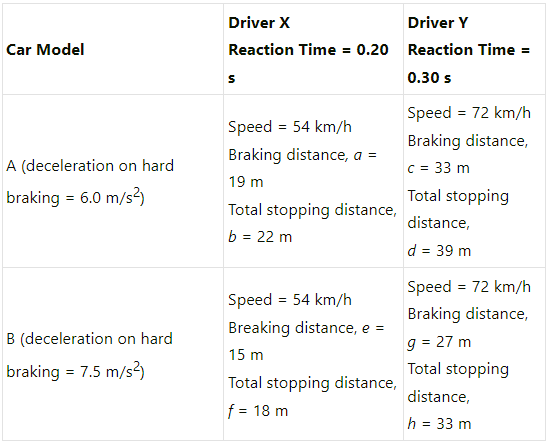
Ans ) for car model A Driver x , deceleration = 6 m/s 2 speed = 54* 5/18 = 15 m/s reaction time = 0.2 sec , distance covered during reaction time = 15 * (0.2) = 3 m
Stopping distance V2 – U2 = 2 a S , S = V2 – U2 / 2 a , S = 02 – 15 2 / 2 (6) = 225 / 12 = 18.75 m = 19 m
Total distance = 19 + 3 = 22 m
Driver y , deceleration = 6 m/s 2 , speed = 72 * 5/18 = 20 m/s , reaction time= 0.3 sec , distance covered during reaction time = 20 * 0.3 = 6 m
Stopping distance V2 – U2 = 2 a S , 0 2 – 20 2 = 2 (6) S , S = 400/ 12 = 33.3 m ,
Total distance = 33 + 6 = 39 m
21) A police jeep is chasing a culprit going on a motor bike . The motorbike crosses a turning at a speed of 72km/h. The jeep follows it at a speed of 90km/hr crossing the turning ten seconds later than the bike. Assuming that they travel at constant speeds , how far from the turning will the jeep catch up with the bike ?
Ans ) speed of thief bike = 72 * 5/18 = 20 m/s , speed of police jeep = 90 * 5 /18 = 25 m/s
Distance covered by thief vehicle when police just try to starts = 20 * 10 = 200 m
Relative distance S = Ut + ½ a t2 , 200 = (25- 20)t + ½ 0 t2 , 200 = 5 t , t = 40 sec
Distance covered by police jeep = 25 * 40 = 1000 metre ,
22) A car travelling at 60 km/h overtakes another car travelling at 42km/hr . Asssuming each car to be 5m long , find the time taken during the overtake and the total road distance used for the overtake ?
Ans ) car A travelling 60 km/hr = 60 * 5/18 = 50/3 m/s , car B travelling = 42 * 5/18 = 35/3 m/s ,
Time = distance / relative speed = 5+ 5 / (50/3 – 35/3 ) = 10 / (15/3) = 10 / 5 = 2 sec ,
For overtake 50/3 = distance/2 , distance = 100/3 m , total distance = 33.3 + own length = 33.3 + 5 = 38.3 m
23)A ball is projected vertically upward with a speed of 50 m/s find a) the maximum height b) the time to reach the maximum height c) the speed at half the maximum height (g=10m/s2)
Ans ) u = 50 m/s a) v2 – u2 = 2 as , 0 2 – 50 2 = 2 * (-10) * h , h(maximum height ) = 2500/20= 125 metre , b) time to reach max height V = U + a t , 0 = 50 + (-10) T , T = 5 sec
c) speed at half the max the maximum height = 125/2 , V2 – U2 = 2 a S , 0 2 – U 2 = 2 *(10)* 125/2 , U2 = 1250 , U = √1250 = 35 m/s
24)A ball is dropped from ballon going up at a speed of 7 m/s . if the ballon was at a height 60m at the time of dropping the ball , how long will the ball take in reaching the ground ?
Ans ) U = 7 m/s , h = 60 metre , h= Ut + ½ a t2 , – 60 = 7*t – ½(10) t2 , 5t2 -7t-60 =0 , 5t2 -12 t + 5t – 60 = 0 , t = -(-12) ±√b2 – 4 a c / 2 a , t = 12 ± √144 – 4 * 5 * (-60) / 2 * 5 = 4.8 sec
25)A stone is thrown vertically upward with a speed of 28m/s . a) Find the maximum height reached by the stone b) Find its velocity one second before it it reaches the maximum height c) Does the answer of part b)change if the initial speed is more than 28 m/s such as 40m/s or 80 m/s ?
Ans) a) U = 28 m/s , V2 – U2 = 2 a S , 0 2 – 28 2 = 2 (-10) H , H = 39.2
b) Find its velocity one second before it reaches the maximum height
V = U + a t , 0 = 28 + (-10) t , t = 2.8 sec
V= U + a t , 0 = u + (-10) * 1 , u = 10 m/sec
26)A person sitting on the top of a tall building is dropping balls at regular intervals of one second . Find the positions of the 3rd,4th,5th ball when the 6th ball is being dropped .
Ans ) position of 3rd ball , 3 sec completed for 3rd ball s = ½ gt2 = ½ (10) (3)2 = 5* 9 = 45 m
Position of 4th ball , 2 sec completed s = ½ gt2 = ½ (10)(2)2 = 5 (4) = 20 m
Position of 5th ball , 1 sec completed s = ½ gt2 = ½ (10)(1) 2 = 5(1) = 5 m
27) A healthy young man standing at a distance of 7 m from a 11.8 m high building sees a kid slipping from the top floor ,with what speed (assumed uniform ) should he run to catch the kid at the arms height (1.8m) ?
Ans : s = ½ gt2 = ½ (10) t2 , 10 = 5 t2 , t = √2 sec
S= ut, 7 = u √2 , u = 7 /√2 m/s
28) An NCC parade is going at a uniform speed of 6km/hr through a place under a berry tree on which a bird is sitting at a height of 12.1 m . At a particular instant the bird drops a berry . which cadet (give the distance from the tree at the instant) will receive the berry on his uniform ?
Ans :U = 6 km/hr = 6*5/18 = 5/3 m/s , bird sitting at a height 12.1 m
S= 1/2gt2 , 12.1 = ½ (10)(t)2 , t = √2.42
Distance covered = Ut ,S= 5/3 * √2.42 = 2.58 m
29) A ball is dropped from height . if it takes 0.200 sec to cross the last 6.00m before hitting the ground , find the height from which it was dropped ?
Ans)h-6 = ½ (10)(t-0.2)2 , S = Ut + ½ g t2 , 6 = U(0.2) – ½ (10) (0.2) 2 , u = 31 m/s
V2 – U2 = 2 g H , 31 2 – 0 2 = 2 * 10 * H , H = 48.05
30)A ball is dropped from height of 5 m onto a sandy floor and penetrates the sand up to 10 cm before coming to rest . find the retardation of the ball in sand assuming it to be uniform .
Ans) V2 – U2= 2gH , V2 = 2(10)(5), V= √100 = 10 m/s (motion in air )
V2 – U2 = 2 a H , 0 2 – 10 2 = 2 * a * (0.1), a = 100/0.2 , a= 500 m/s2
31)An elevator is descending with uniform acceleration . To measure the acceleration , a person in the elevator drops a coin at the moment the elevator starts . The coin is 6ft above the floor of elevator at the time it is dropped . The person observes that the coin strikes the floor in 1 second . calculate from these data the acceleration of the elevator ?
Ans ) S = Ut + ½ (g+a)t2 ,- 6 = 1/2 -(32.2 + a ) 1 2 , 12 = 32.2 +a , a = 20.2 ft/sec2
32)A ball is thrown horizontally from a point 100 m above the ground with a speed of 20 m/s. Find (a) the time it takes to reach the ground, (b) the horizontal distance it travels before reaching the ground. (c) the velocity (direction and magnitude) with which it strikes the ground .
Ans) Ball is thrown horizontally from a point 100 m above the ground with speed of 20 m/s a) time taken to reach the ground s = ut + ½ at2 , y = Uy t + ½ a t2 , -100 = ½ (-10) t2 , 20 = t2 , t = 2√5 sec = 4.5 sec b) Horizontal distance it travels before reaching the ground
X = Ux t + ½ ax t2 , R = 20 * T , R= 20 * 4.5 = 90 metre
c)the velocity with which it strikes the ground
V2 – U2 = 2 a S , Vy 2 – Uy 2 = 2 ay . H , Vy 2 = 2 (10) 100 , Vy = √2000 , Vy = 45 m/s
V= U + a t , Vx = Ux = 20 m/s resultant speed = √ Vx 2 + Vy 2 = √20 2 + 45 2 = √2425 = 49 m/s , tan θ = Vy/Vx = 45/20 = 2.25 , θ= tan-1(2.25) = 66 °
33)A ball is thrown at a speed of 40 m/s at an angle of 60 ° with the horizontal. Find a. the maximum height reached and b. the range of the ball. Take . g = 10 m/s2
Ans)(maximum height)H = U2 sin 2 θ / 2 g , H = 40 2 ( sin 60°)2/2(10) , H = 1600 * √3 / 2 * 2 *10 , H = 40√3
Range of the ball R = U2 sin2θ / g , R = 40 2 sin 120° /10 , R = 1600 √3 / 2 * 10 = 80√3 metre
34) In a soccer practice session the football is kept at the centre of the field 40 yards from the 10 ft high goalposts. A goal is attempted by kicking the football at a speed of 64 ft/s at an angle of 45° to the horizontal. Will the ball reach the goal post ?
Ans) length of the field = 40 yards = 40 * 3ft = 120 ft (1yard = 3 ft point to remember ) , height of goal post is 10 ft
Projection speed = 64 ft/s angle of projection = 45° , S = U t + ½ a t2 , for horizontal motion
X = Ux t + ½ ax t2 , 120 ft = 64 cos 45° * t , 120 = 64 * 1/√2 * t , t = 2.625 ,
Y = Uy t + ½ ay t2 , Y = 64 sin 45° * 2.625 – ½(32.1 ft/s2)(2.625)2 = 118.8 – 110.59 = 7.41 ft ,
As value of Y is 7.41 ft which is less than 10ft . Hence ball reach the goal post .
35) A popular game in Indian villages is goli which is played with small glass balls called golis. The goli of one player is situatted at a distance of 2.0 m from the goli of the second player. This second player has to project his goli by keeping the thumb of the left hand at the place of his goli, holding the goli between his two middlefilngers and making the throw. If he projected is 19.6 cm from the ground and the goli is to be projected horizontally, with what speed shold it be projected so that it directly hits the stationary goli without falling on the ground earlier?
Ans)S = U t + ½ a t2 , For horizontal motion X = Ux T , 2 = Ux . T , putting T value in this equation , 2 = Ux . 0.2 , Ux = 10 m/s
For vertical motion Y = ½ g T2 , 19.6 cm = 0.196 m ,
0.196 = ½ (10) T 2 , T= 0.2 sec
36) Figure shows a 11.7 ft wide ditch with the approach roads at and angle of with the horizontal. With what minimum speed should a mororbike be moving on the road so that it safely croses the ditch?
Assume that the length of thebike is 5 ft, and it leaves the road when the front part runs out of the approch road.
Ans ) Y = tan θ . x – (g /2 u2 cos2θ )x2 (trajectory equation )
As Y = 0 for vertical displacement with one complete rotation
0 = tan θ . x – (g /2 u2 cos2θ )x2 , tan θ . x = (g /2 u2 cos2θ )x2
tan θ = g/2 U 2 cos 2 θ .x , U = √g/2 sinθ . cosθ .x , U = 32 ft/s
37) A person standing on the top of a cliff 171 ft high has to throw a packet to his friend standing on the ground 228 ft horizontally away. If he throws the packet directly aiming at the friend with a speed of 15.0 ft/s, how short will the packet fall?
Ans ) (angle of packet throw wrt x axis )tan θ = 171/228 , θ = 37°
X = U cosθ * t , X = 15 cos 37° * 3.5 , X = 42 m
Y = Usinθ * t – ½ gt2 , -171 = 15 * sin 37° * t – ½ (32.2) (t) 2 , -171 = 9 t – 16t2 , 16t2 – 9t -171 = 0 , t = -(-9) ±√ 81 – 4*16*(-171)/2 * 16 , t = 9± 105 /32 , t = 3.5 sec
Falling short along x axis = 228 – 42 = 186 m
38) A ball is projected from a point on the floor wilth a speed of 15 m/s at an angle of with the horizontal. Will ilt hit a vertical wall 5 m away from the point of projection and perpendiculaer to the plane of projection without and perpendicular to the plane of projection without hitting the floor? will the answer differ if the wall is 22 m away?
Ans ) Distance along x axis is , X = U2 sin 2θ / g , X = 15 2 sin 2*60°/10 , X = 225*√3/20 , X = 19.46 m
In case of 5m vertical wall it will strike on the target .
In case of 22m vertical wall it will not strike on the target as horizontal distance calculated to be 19.46 .
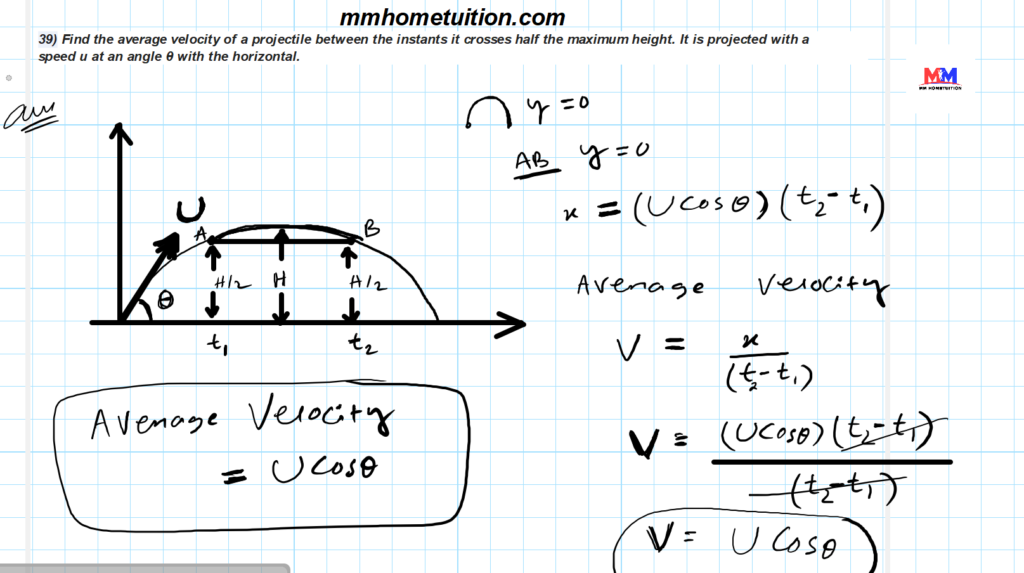
39) Find the average velocity of a projectile between the instants it crosses half the maximum height. It is projected with a speed u at an angle θ with the horizontal.
Ans ) projection after H/2 from begining to H/2 at end . vertical displacement is zero , we have to find horizontal distance = Ucosθ (t2 – t1)
Average velocity = horizontal distance / time interval = Ucosθ (t2 – t1)/(t2-t1)= U cosθ
40) A bomb is dropped from a plane flying horizontally with uniform speed. Show that the bomb will explode vertically below the plane. Is the statement true if the plane flies with uniform speed but not horizontally ?
Ans ) when plane is flying horizontally then X = U * t (for bomb), (U is the speed of plane , U is also horizontal speed of bomb)
X = U * t (for plane ), for both plane and bomb both attains same horizontal distance
When plane is projected with U speed but makes an angle θ with horizontal , then X = Ux * t (for plane ) (U is the speed of plane)
X = Ux * t (for bomb )(U is the speed of bomb)
for both plane and bomb attains same horizontal distance when plane is projected at an angle θ
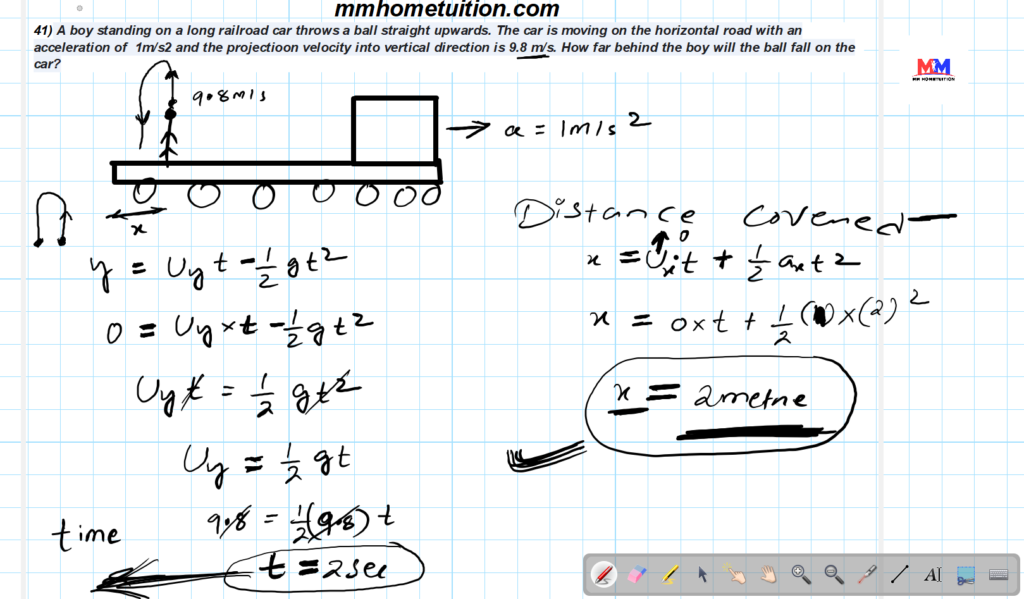
41) A boy standing on a long railroad car throws a ball straight upwards. The car is moving on the horizontal road with an acceleration of 1m/s2 and the projectioon velocity into vertical direction is 9.8 m/s. How far behind the boy will the ball fall on the car?
Ans) time taken by ball reach at boy from projection upward to catch = Y = Uyt – ½ g t2 , 0 = 9.8 t – ½ (9.8) t2 , 9.8 * t = ½ (9.8) t2 , t = 2 sec
Horizontal distance covered = x = Uxt + ½ a t2 , X = 0*t + ½ 1 * (2)2 , X= 2 metre
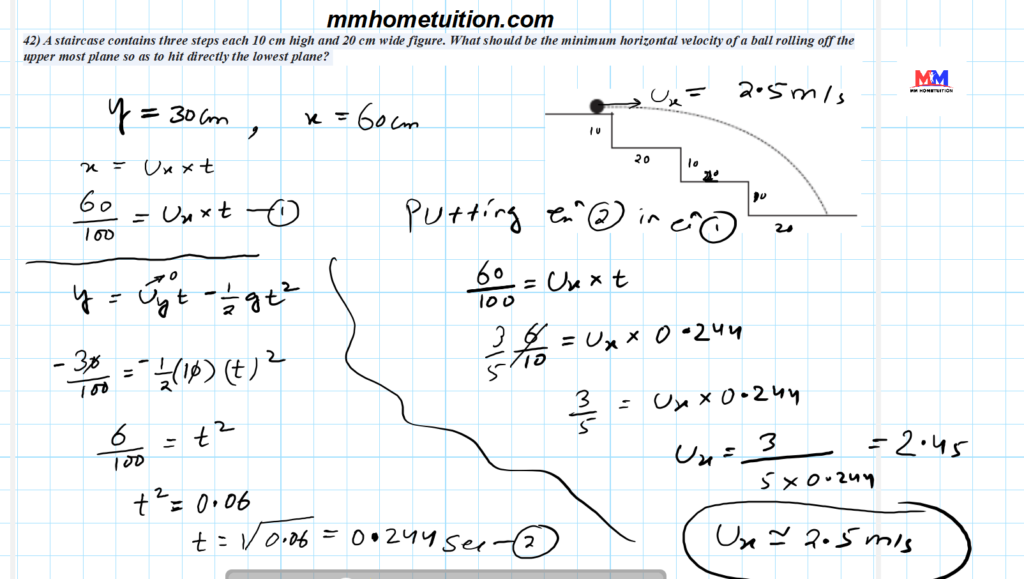
42) A staircase contains three steps each 10 cm high and 20 cm wide figure. What should be the minimum horizontal velocity of a ball rolling off the upper most plane so as to hit directly the lowest plane?
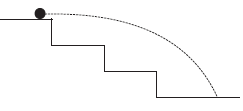
Ans ) horizontal distance covered = 3* 20 cm = 60 cm = 0.60m
Vertical distance = 3*10 cm = 30 cm
Uy t – ½ (10) t2 = – 0.30, Uy= 0 , 5 t 2 = 0.30 ,
t2= 0.06 , t = 0.244 ,
from above time t = 0.244sec ,
Ux t = 0.60 , Ux (0.244) = 0.60 , Ux= 2.45 m/s
Hence min horizontal velocity velocity of ball = 2.45 m/s
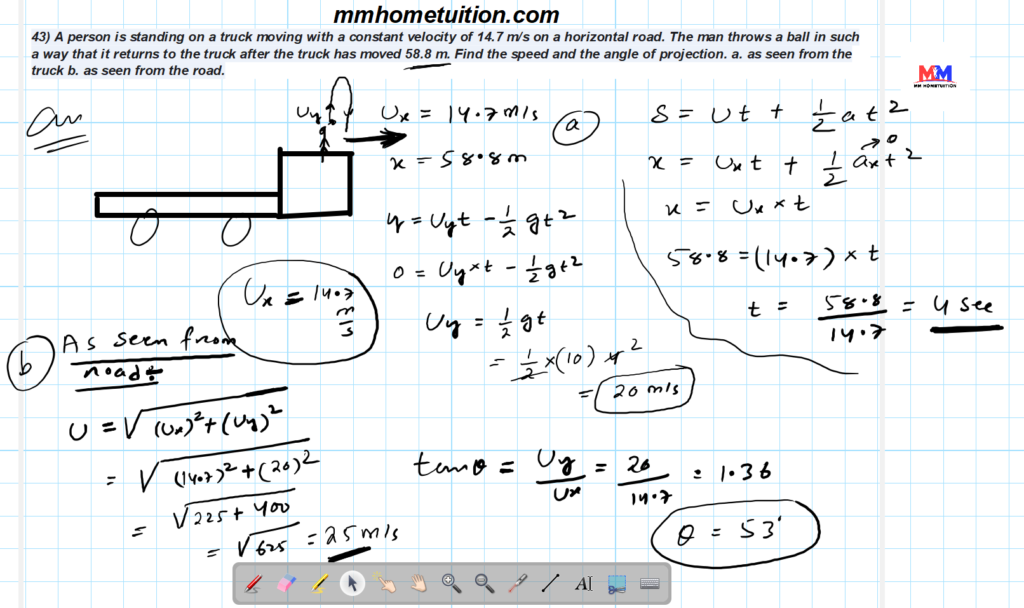
43) A person is standing on a truck moving with a constant velocity of 14.7 m/s o a hrozontal road. The man throws a ball in such a way that it returns to the truck after the truck has moved 58.8 m. Find the speed and the angle of projection. a. as seen from the truck b. as seen from the road.
Ans ) A) as seen from the truck
(Speed of truck )Ux = 14.7 m/s , X= R = 58.8 m , X= Ux t , t = X / Ux = 58.8/14.7 = 4 sec
Uy (speed of ball ), θ = 90° , Y= Uy t – ½ gt2 , 0 = Uy t – ½ gt2 , Uy t = ½ gt2 , t = 2 * Uy/g , 4 = 2 * Uy/10 , Uy = 40/2 = 20 m/s
B) as seen from the road
Uy = 20 m/s
Ux = 14.7 m/s horizontal speed of truck
Resultant speed of truck = U = √Ux 2 + Uy 2 , U = √(14.7)2 + (20)2 , U = √216.09 + 400 = √616.09 = 24.82
Tan θ = Uy/Ux = 20/14.7 = 1.36 , θ = 53.67°
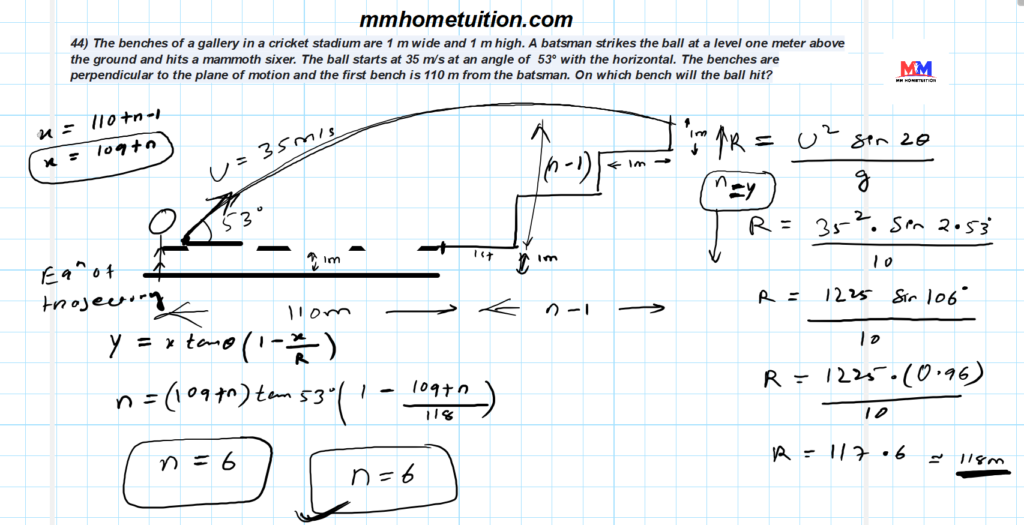
44) The benches of a gallery in a cricket stadium are 1 m wide and 1 m high. A batsman strikes the ball at a level one meter above the ground and hits a mammoth sixer. The ball starts at 35 m/s at an angle of 53° with the horizontal. The benches are perpendicular to the plane of motion and the first bench is 110 m from the batsman. On which bench will the ball hit?
Ans ) Horizontal Range R = U2 sin 2θ / g , R = 35 2 sin 106 ° / 10 = 1225 * 0.96/10 = 117.6 m = 118 m
Let Y = n = Height of stadium
X = 110 + (n-1) = 109 + n
Y = tan θ . X (1 – X/R) , n = tan 53° . 109 + n (1 – 109+n/118 ), n = (1.32 )109+n (9-n/118 ) , 118 . n = 1.32(109 * 9 – 109n + 9n –n2) , 118 . n = 1.32 (109 * 9 – 100 n – n2 ) , 90 n = 981 – 100n – n2 , n2 +190n -981 = 0 , n= -190±√190 2 – 4 * 1 * (-981)/ 2 * 1 , n = 6
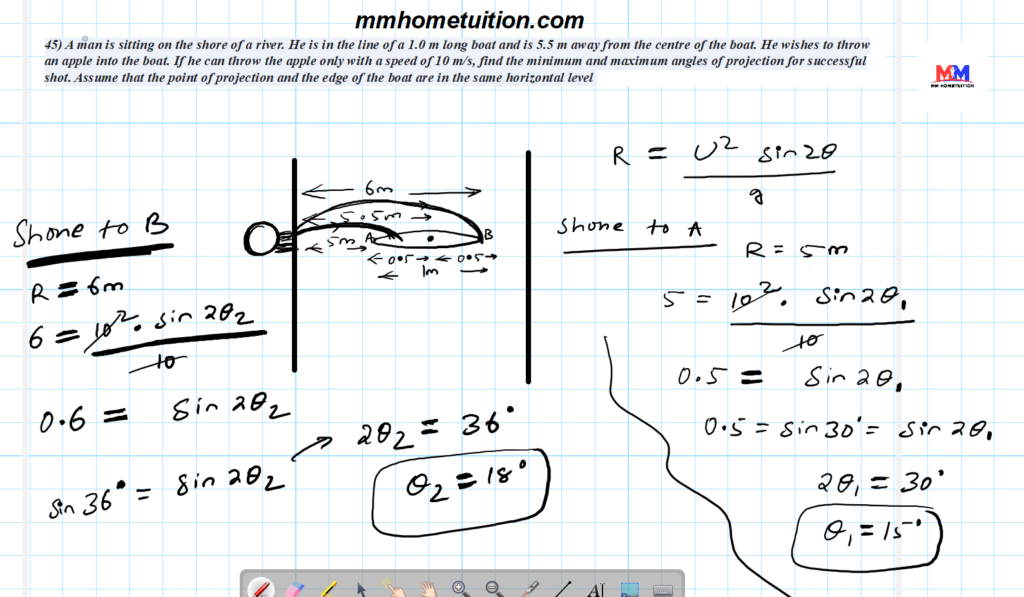
45) A man is sitting on the shore of a river. He is in the line of a 1.0 m long boat and is 5.5 m away from the centre of the boat. He sishes to throw an apple into the boat. If he can throuw the apple only wihta speed of 10 m/s, find the minimum and maximum angles of projection for successful shot. Assume that the point of projection and the edge of the boat are in the same horizontal level
Ans ) length of the boat is 1m ,(centre to one side is 0.5 m , centre to another side 0.5 m ) man sitting on the shore of river
Distance from boat centre to man is 5.5 m
Shore to near end of boat is 5 metre , shore to far end of boat is 6 metre
Projection R = U2 sin 2θ / g , 5 = 10 2 sin 2θ/ 10 , 50 /100 = sin 2θ , 1/2 = sin 2θ ,
2θ = 30 ° , θ min = 15 °
Projection R = U2 sin 2θ/ g , 6 metre = 10 2 sin 2θ/10 , 0.6 = sin 2θ , 2θ = sin-1(0.6),
2θ = 37° , θ = 18.5 °
46) A river 400 m wide is flowing at a rate of 2.0 m/s. A boat is sailing at a velocity of 10 m/s with respect to the water, in a direction perpendicular to the river. (a) Find the time taken by the boat to reach the opposite bank. (b) How far from the point directly opposite to the starting point does the boat reach the opposite bank?
Ans ) Distance = 400 m, Vr = 2 m/s , Vbr = speed of boat wrt river = 10 m/s ,
a) time taken by boat to reach the opposite bank = t = S/V , t = 400/10 = 40 sec
b) Distance directly opposite to starting point due to river flow = Vr * t = 2 * 40 = 80 m
47) A swimmer wishes to cross a 500 m wide river flowing at 5 km/h. His speed with respect to water is 3 km/h. (a) If he heads in a direction making an angle θ with the flow, find the time he takes to cross the river. (b) Find the shortest possible time to cross the river.
Ans ) Distance = 500 m ,Vr = 5 km/r = 5* 5/18 = 25/18 m/s Vsr= 3km/hr=3*5/18= 5/6 m/s
a) time he takes to cross the river = t = 500/ Vsr sinθ , t = 500 / 5/6 sinθ , t = 600 / sinθ sec
b) shortest possible time to cross river t = 500/vsr = 500 / 5/6 = 600 sec
48) Consider the situation of the previous problem. The man has to reach the other shore at the point directly opposite to his starting point. If he reaches the other shore somewhere else, he has to walk down to this point. Find the minimum distance that he has to walk
Ans) Drift distance(DD) = (5 + 3 cosθ) 0.5/3 sinθ , min distance d/dθ((5 + 3 cosθ) 0.5/3 sinθ ) = 0 , d/dθ((5 + 3 cosθ) /6 sinθ ) = 0 , solving this cos θ = -3/5 , sinθ = 4/5 , putting this value in the expression Drift Distance = 2/3 km
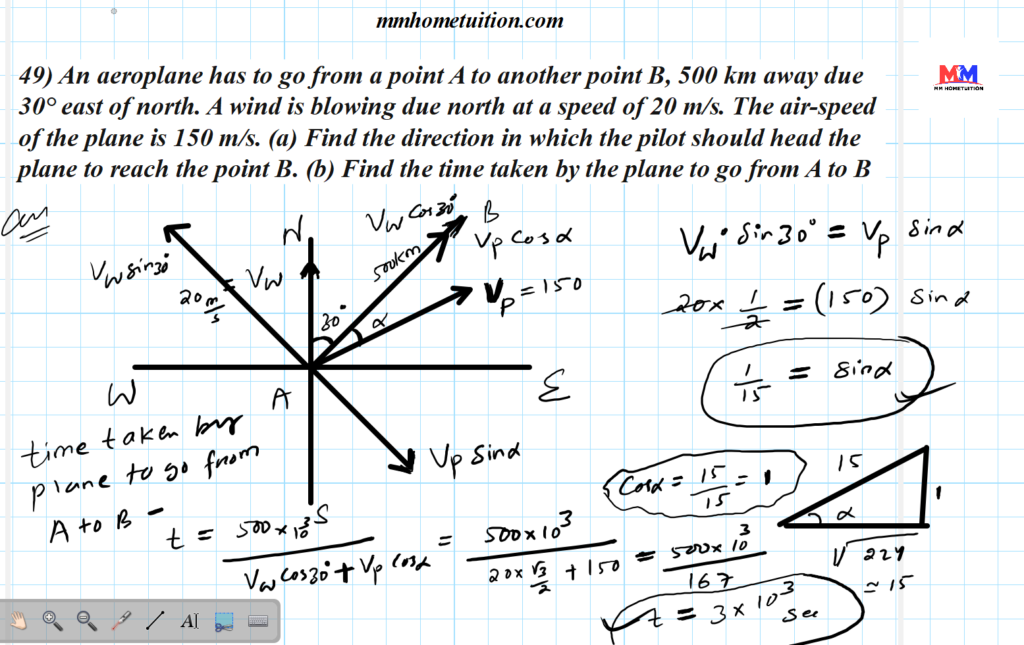
49) An aeroplane has to go from a point A to another point B, 500 km away due 30° east of north. A wind is blowing due north at a speed of 20 m/s. The air-speed of the plane is 150 m/s. (a) Find the direction in which the pilot should head the plane to reach the point B. (b) Find the time taken by the plane to go from A to B
Ans) Aeroplane has to go from A to B 500 km away due 30° east of north .
Wind speed 20 m/s along north , plane speed 150 m/s
Vw sin 30° = Vp sin∝ —–1)
20 * ½ = 150 . sin∝ , sin∝ = 1/15 , cos ∝ = 1
Time taken by plane to go from A to B
T = S/Vw cos30° + Vp cos ∝ , T = 500 * 10 3 / 20 cos 30 ° + 150 cos ∝ ,
T = 500 * 10 3 / 167 = 3 * 10 3 sec
50) Two friends A and B are standing a distance x apart in an open field and wind is blowing from A to B. A beats a drum and B hears the sound t1 time after he sees the event. A and B interchange their positions and the experiment is repeated. This time B hears the drum t2 time after he sees the event. Calculate the velocity of sound in still air v and the velocity of wind u. Neglect the time light takes in travelling between the friends
Ans) a) t1 = X /V+U , t2 = X /V-U
( V+U )= x/t1 —–(1),V-U = x/t2 ——-(2)
Adding 1 and 2 we get , 2V= x/t1 + x/t2 , V= x/2(1/t1+1/t2) ——3)
Subtracting 2 from 1 we get , 2U = x/t1 – x/t2 , U = x/2(1/t1 – 1/t2) ——4)
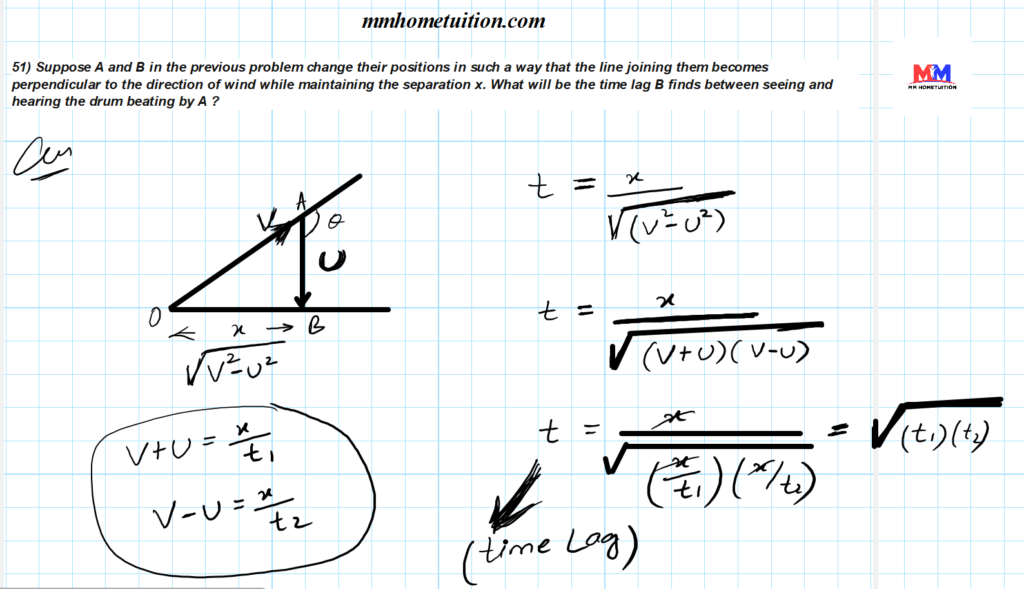
51) Suppose A and B in the previous problem change their positions in such a way that the line joining them becomes perpendicular to the direction of wind while maintaining the separation x. What will be the time lag B finds between seeing and hearing the drum beating by A ?
Ans)time t = displacement / speed = x / √V2 – U2
52) Six particles situated at the corners of a regular hexagon of side a move at a constant speed v. Each particle maintains a direction towards the particle at the next corner. Calculate the time the particles will take to meet each other .
Ans)t = x/Vcos60° = 2x/V