

1. Algebra
Algebra is fundamental to almost every numerical problem. Students should be comfortable with:
- Rearranging equations
- Solving simultaneous equations
- Working with ratios
- Handling powers and roots
- Simplifying expressions
2. Trigonometry
Trigonometry becomes particularly important in mechanics, vectors, waves and rotational motion.
Students should understand sine, cosine and tangent and be able to resolve vectors into components.
3. Graphs
Graphs are an important bridge between mathematics and physics. Students should learn how to interpret position-time, velocity-time and other physical graphs.
Understanding the slope and area of graphs can make many physics problems much easier.
4. Vectors
Vectors are essential for understanding displacement, velocity, acceleration, force, momentum and many other physical quantities.
A student who develops strong vector skills will generally find mechanics problems easier to analyze.
OBJECTIVE 1
1)A vector is not changed if a)it is rotated through an arbitrary angle b)it is multiplied by an arbitrary scalar c) it is cross multiplied by a unit vector d)it is slid parallel to itself
ans) d
2)Which of the sets given below may represent the magnitudes of three vectors adding to zero ? a)2,4,8 b)4,8,16 c)1,2,1 d)0.5,1,2
ans) c
3)The resultant of A and B makes an angle ∝ with A and β with B a) ∝ < β b)∝ < β if A < B c) ∝ < β if A > B d) ∝ < β if A = B
ans) c
4)The component of a vector is a) always less than its magnitude b) always greater its magnitude c) always equals to its magnitude d) none of these
ans) d
5)A vector A points vertically upward and B points towards north . The vector product A * B is a) along west b) along east c) zero d) vertically downward
ans ) a
6)The radius of a circle is stated as 2.12cm . its area should be written as a)14 cm2 b) 14.1 cm2 c) 14.11 cm2 d) 14.1124 cm2
ans ) b
OBJECTIVE 2
1)A situation may be described by using different sets co-ordinate axes having different orientations. Which of the following do not depend on the orientation of the axes? A the value of a scalar B component of a vector C a vector D the magnitude of a vector
ans) a , c , d
2)Let C= A + B then a)|C| is always grater than |A| b)it is possibal to have |C| <|A| and |C| < |B| C) is always equal to A+B d) is never equal to A+B
ans ) b
3)Let the angle between two nonzero vector A and B be 120 degree and its resultant be c . a)C must be equal to A-B b)C must be less than A-B c) C must be greater than A-B d) C may be equal to A-B
ans ) c
4)The x-component of the resultant of several vectors A is equal to the sum of the x-components of the vectors B may be smaller than the sum of the magnitudes of the vector C may be greater than the sum of the magnitude of the vectors D may be equal to the sum of the magnitude of the vectors.
ans ) a,b,d
5)The magnitude of the vector product of two vectors A and B may be: A Greater than AB B Equal to A B C less than AB D) Equal to zero
ans ) b,c,d
EXERCISES
1)A vector A makes an angle of 20 degree and B makes an angle of 110 degree with x axis . The magnitude of these vectors are 3 m and 4 m respectively . Find resultant ?
ans: (Resultant ) R = √A2 + B2 + 2 A B cosθ , R = √3 2 + 4 2 + 2 .3 . 4 cos 90 = √ 9 + 16 + 0 = √25 = 5
2)Let A and B be the two vectors of magnitude 10 unit each . if they are inclined to x axis at angle 30 degree and 60 degree respectively , find resultant ?
ans :√ 10 2 + 10 2 + 2 . 10 . 10 cos 30 = √373= 19
3)Add vectors A,B and C each having magnitude of 100 unit and inclined to x axis at angles 45 degree , 135 degree , 315 degree respectively . Find resultant ?
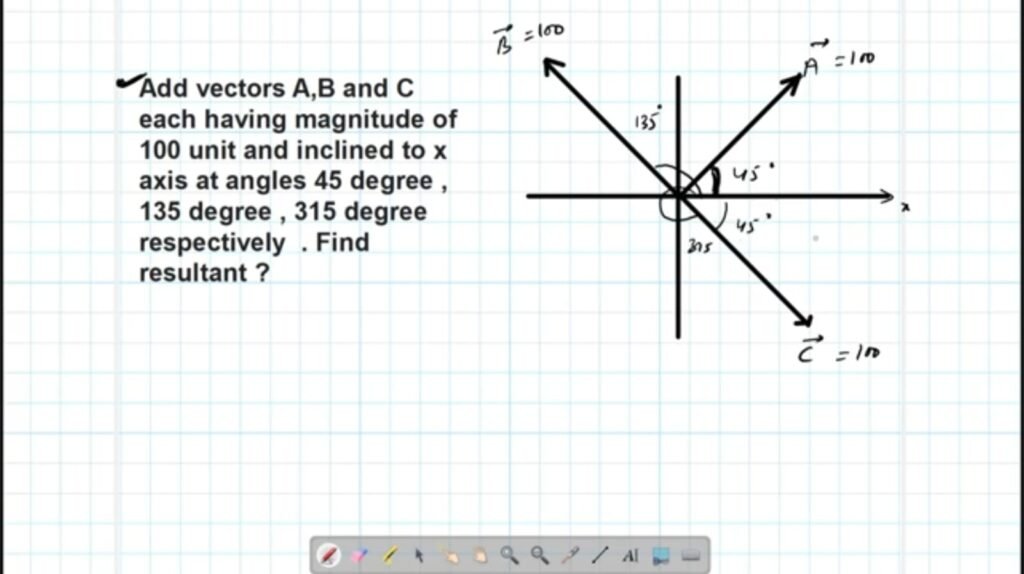
Ans : A = 100 , Ax = 100 cos 45 = 100 * 1/√2 Î , Ay = 100 sin 45 = 100 * 1/√2 Ĵ
B = 100 , B x = 100 cos 135 = 100 * 1/√2 -Î , B y = 100 sin 135 = 100 * 1 / √2 Ĵ
C= 100 , Cx = 100 cos 315 = 100 * 1/√2 I , Cy = 100 sin 315 = 100 *1/√2 (-j)
Rx = Ax + Bx + Cx = 100/√2 + 100/√2 – 100/√2 = 100 / √2 , R y = Ay + By + Cy = 100/√2 + 100 / √2 – 100 /√2 , R = √ Rx2 + Ry2 = √(100/√2 )2 + (100/√2)2 = 100
4)Let a= 4i+3Ĵ and b= 3i + 4Ĵ a)find the magnitues of a) a b) b c) a+b d) a-b
Ans : |a| = √4 2 + 3 2 = √ 16 + 9 = √25 , 5
|b|= √3 2 + 4 2 = 5
|c| = √7 2 + 7 2 = 7 √2
|d| = √1 2 + 1 2 = √2
5) Refer to figure .Find a) the magnitude b) x and y components and c the angle with the x axis of the resultant of OA , BC,DE .
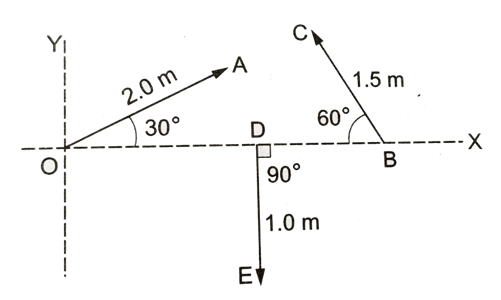
Ans :A) OA = 2 metre , (OA )X = 2 COS 30 ° = 2 * √3 / 2 = √3
(OA )Y = 2 SIN 30 = 2 * ½ = 1
B) BC (BC )X= BC COS 60 ° = (1.5 )/2 = – 0.75
(BC )Y= BC SIN 60 °= (1.5)* √3/2 = 0.75 * √3= 1.29
C) DE (DE)x = 0 , (DE)y =1(-Ĵ)
6)Two vector have magnitudes 3 units and 4 units respectively . what should be the angle between them if the magnitude of the resultant is a) 1 unit b) 5 unit c) 7 unit
Ans : a ) R = 1 R2 = A2 + B2 + 2AB COSθ , 1 2 = 3 2 + 4 2 + 2. 3. 4 COS θ , θ = 180 °
b) R= 5 , R2 = A2 + B2 + 2AB COSθ , 5 2 = 3 2 + 4 2 + 2 . 3. 4 COS θ , θ = 90 °
C) R = 7 , 7 2 = 3 2 + 4 2 + 2. 3. 4 COS θ ,
θ= 0 °
7) A spy report about a suspected car reads as follows. The car moved 2.00 km towards east, made a perpendicular left turn, ran for 500 m, made a perpendicular right turn, ran for 4.00 km and stopped. Find the displacement of the car.
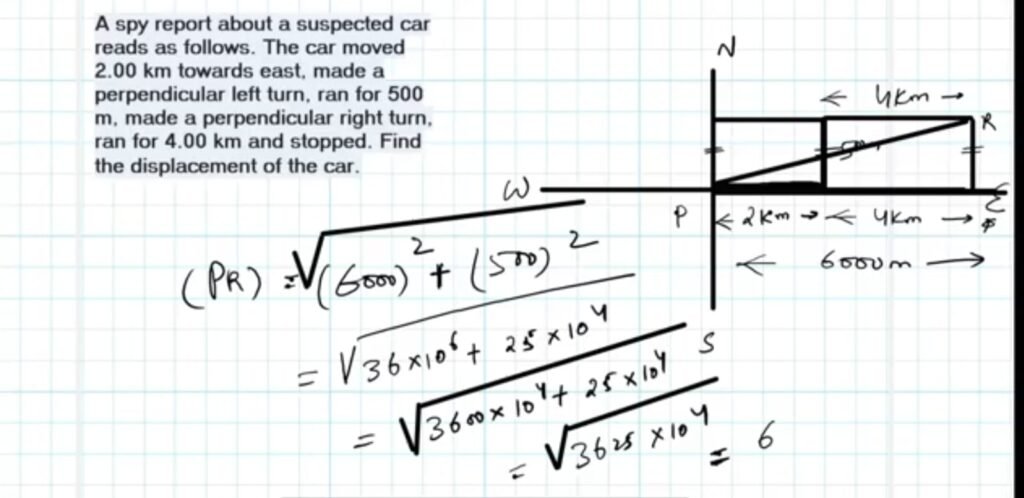
Ans : PR = √ 6000 2 + 500 2 = 6
8) A carrom board(4ft*4ft) has the queen at the centre. The queen hit by the striker moves to the front edge, rebounds and goes in the hole behind the striking line. Find the magnitude of displacement of the queen
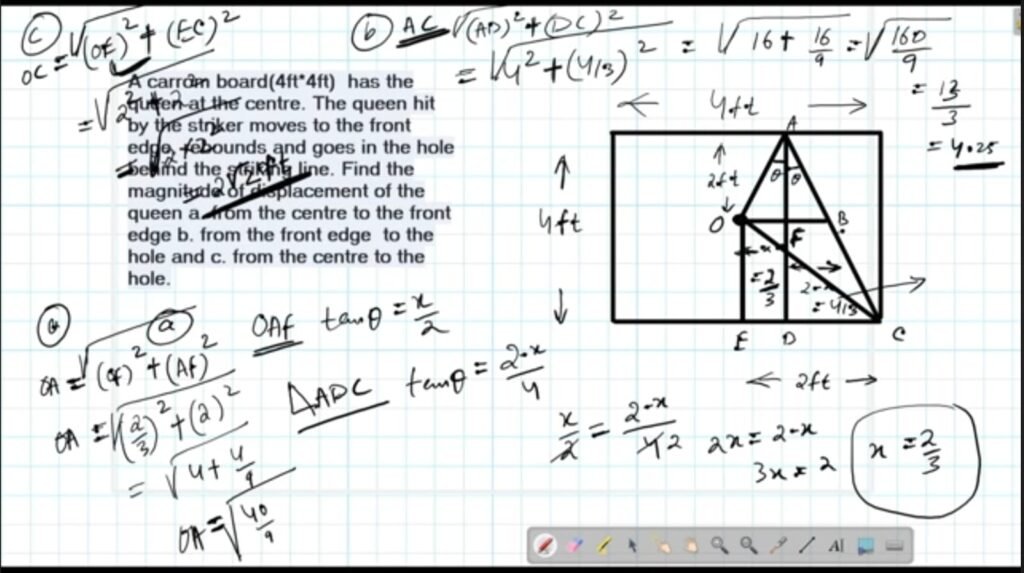
a. from the centre to the front edge
b. from the front edge to the hole and
c. from the centre to the hole .
Ans : a) OA = √ OF 2 + AF2 = √ (2/3) 2 + (2) 2 = √40/9
IN OAF tan θ = x/2 , IN ADC tan θ = 2-x /4 , x/2 = 2-x/4 , x= 2/3 ,
b) AC = √ AD2 + DC 2= √4 2 + 4/3 2 = √16 + 16/9 = √160/9 = 4.25
c)OC = √OE 2 + EC 2 = √2 2 + 2 2 = 2 √2
9) A mosquito net over a (7ft*4ft) bed is 3 ft high. The net has a hole at one corner of the bed through which mosquito enters the net it flies and sit at the diagonally opposite upper corner of the net.
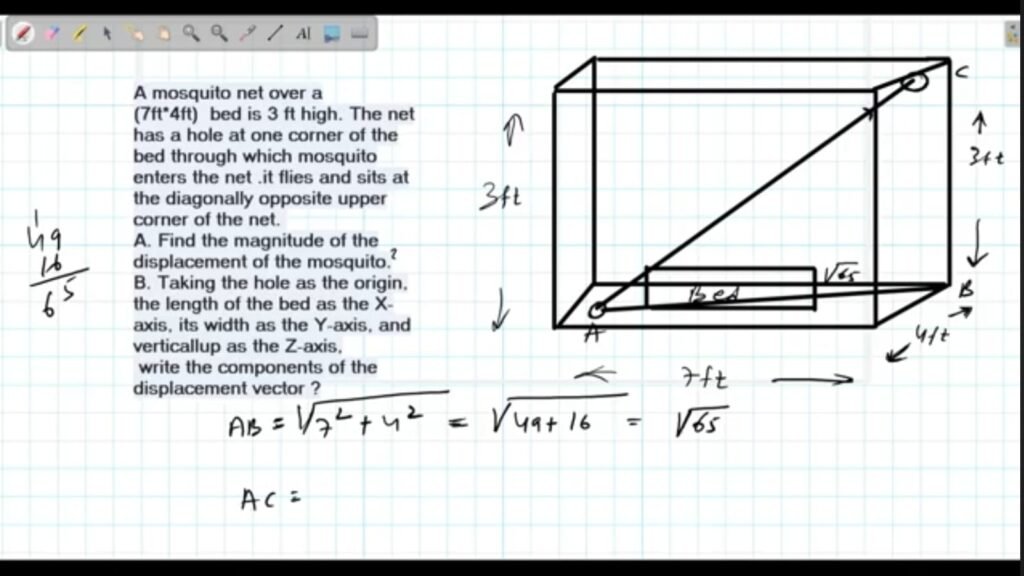
A. Find the magnitude of the displacement of the mosquito.
B. Taking the hole as the origin, the length of the bed as the X-axis, its width as the Y-axis, and vertically up as the Z-axis, write the components of the displacement vector ?
Ans : A ) displacement = √7 2 + 4 2 + 3 2 = √ 49+ 16 +9 = √49+25 = √74
B) components of displacement vector 7 ft for x axis , 4 ft for y axis , 3ft for z axis .
10) Suppose a is a vector of magnitude 4.5 unit due north. What is the vector a) 3a b) -4a ?
Ans : a) 3 * 4.5 Ĵ = 13.5 Ĵ b) – 4 * 4.5 Ĵ = – 18 Ĵ
11) Two vectors have magnitudes 2 m and 3m. The angle between them is 60 degree . Find a the scalar product of the two vectors b. the magnitude of their vector product.
Ans : a) A.B= 2 . 3 cos 60 = 6 * ½ = 3 b) A*B = 2 . 3 sin 60 = 6 √3/2 = 3 √3
12) Let A1 A2 A3 A4 A5 A6 A7 be a regular hexagon. Write the x-components of the vectors representeed by the six sides taken in order. Use the fact that the resultant of these six vectors is zero, to prove that cos 0 + cos π/3 + cos 2π/3 + cos 3π/3 + cos 4π/3 + cos 5π/3 = 0 Use the known cosine values of verify the result .
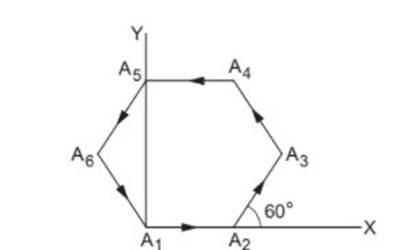
Ans : cos 0 = 1 cos π/3 = ½ cos 2π/3 = -1/2 cos 3π/3 = -1 cos 4π/3 = -1/2 cos 5π/3 = ½
Adding these components result leads to zero
13)Let a= 2i + 3Ĵ +4κ and b= 3i +4Ĵ+5κ . Find the angle between them ?
Ans : cos θ = a . b / |a|.|b|= cos θ = 6 + 12 + 20 / √4+9+16 .√9+16+25 = 38/ √29 √50
14)Prove that A.(A*B)=0
Ans : let A be x axis B be y axis , x . (x* Y ) = X . Z = X . Z cos 90 = zero
15)if A=2i +3 Ĵ+4κ and B= 4i+3Ĵ+2κ , find A*B ?
Ans : A * B = = Î – Ĵ + κ = Î (6- 12) – Ĵ(4-16)+ κ(6-12) = Î(-6)+ 12Ĵ – 6 κ
16)if A,B,C are mutually perpendicular show that C*(A*B)=0 . is the converse true ?
Ans : let A is x axis B is y axis C is z axis , Z*(x * Y )= Z * (Z) = Z . Z sin 0 = 0
17) A particle moves on a given straight line with a constant speed v. At a certain time it is at a point P on its straight line path.O is a fixed point. Show that op * V is independent of the position P?
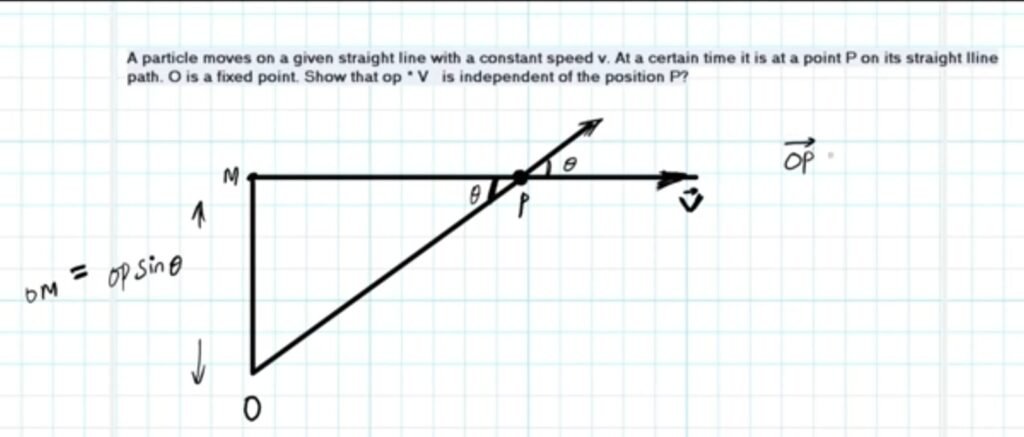
Ans : OP * V = OP sinθ . V = OM * V , OM value remains constant , Hence OP * V is independent of position p .
18) The force on a charged particle due to electric and magnetic field is given by F= qE + q(v*B). suppose E is along x axis and B along Y axis . In what direction and with what minimum speed v should a positively charged particle be sent so that the net force on it is zero ?
Ans : F= qE + q(v*B) , E= E Î , B= B Ĵ , q E Î = q (V κ * B Ĵ ) , E= V * B
19) Give an example for which A.B = C.B but A≠C .
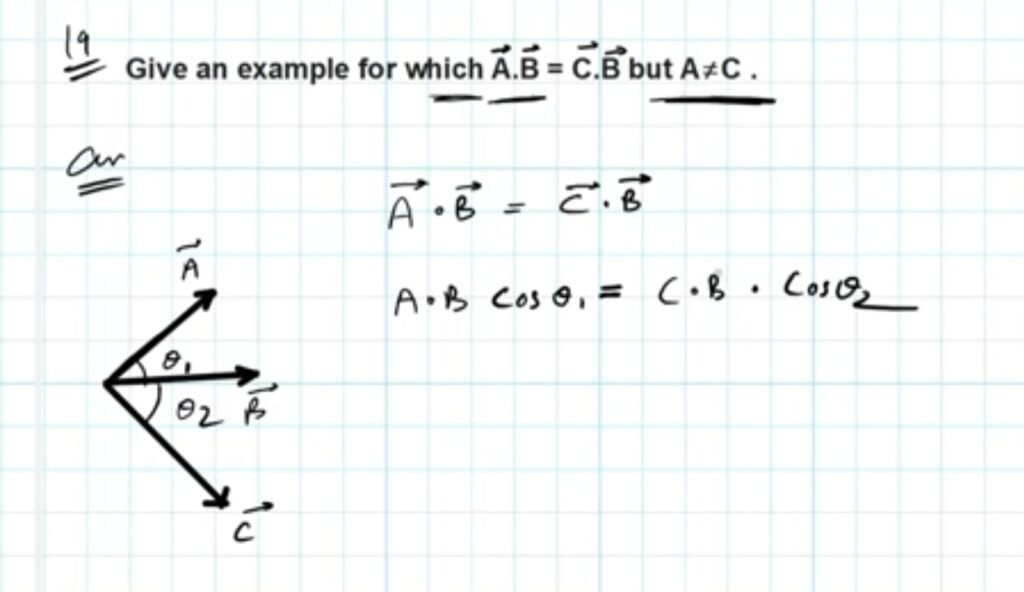
Ans : A. B = C. B , A. B cos θ1 = C. B cos θ2 , A cos θ1 = c cos θ2 , |A| ≠ |C|
20)Draw a graph from the following data . Draw tangents at x=2,4,6 and 8 . Find the slope of these tangents . Verify that the curve drawn is Y= 2×2, and the slope of tangent is tan θ = dy/dx= 4x
X 1 2 3 4 5 6 7 8 9 10
Y 2 8 18 32 50 72 98 128 162 200
Ans:
21)A curve is represented by y= sin x . if x is changed from π/3 to π/3+π/100 , find approximately the change in y ?
Ans :Y = sin x , dy/dx= cos x , dy = cos π/3 . π/100 = ½ . π/100 = π/200
22)The electric current in a charging R-C circuit is given by i= i0 e-t/RC where i0 , R and C are constant parameters of the circuit and t is time . Find the rate of change of current at a) t= 0 b) t= RC c) t= 10 RC
Ans: i= i0 .e-0/RC = i0. , I = i0. e-RC/RC= i0 .e-1 , I= i0. e-10RC/RC = i0.e-10
23)The electric current in a discharing R-C circuit is given by I = i0 e –t/RC where i0, R, C are constant parameters and t is time . Let i0 = 2A , R= 6* 10 5 Ω and C= 0.5 μF a) Find the current at t=0.3 s b) Find the rate of change of current at t=0.3sec c) find approximately the current vat t=0.31 sec
Ans :a) I = i0 e-0.3/6*10 5 * 0.5 *10 -6 = i0 e -0.3/3*10 -1 = i0 e -1 = i0 /e b) di/dt = i0 e-t/RC . –(1/RC) = i0 .e-0.3/6*10 5 * 0.5 * 10 -6 . –(1/6*10 5 * 0.5 * 10 -6) = i0 .e -1 . –(1/0.3)
24)Find the area bounded under curve Y= 3×2+6x+7 the x axis with ordinates at x=5 and x= 10 .
Ans : 10∫5(3×2 + 6x + 7 )dx = 10 ∫5 3×2. dx + 10∫5 6x. dx + 10∫5 7.dx = 3 10 (x3/3)5 + 6 10 (x2/2)5 + 7 10 (x)5 = (10 3 – 5 3 ) + 3 (10 2 – 5 2 ) + 5 (10 – 5 ) = 1125
25) Find area enclosed by the curve Y= sin x and x axis between x=0 and x= π .
Ans : π∫0sin x . dx = π(– cos x )0 = – (cos π – cos 0 ) = – (-1 – 1 )= 2
26) Find the area bounded by the curve Y= e –X the x axis and the y axis .
Ans : ∫ e –X .dx = e –X / d/dx(-x) = e –X . (-1 )
27) A rod of length L is placed along x axis between x = 0 and x= L . The linear density (mass/length) ρ of the rod varies with distance x from the origin as ρ= a + bx a) Find the SI unit of a and b b) Find mass of the rod in terms of a,b,L .
Ans : a) a = kg/meter b = kg/meter 2 b) m∫0dm =L ∫0(a+ bx )dx = L∫0a.dx + L∫0bx.dx = aL + bL2/2
28)The momentum p of a particle changes with time t according to the relation dp/dt = 10 + 2t . if the momentum is zero at t=0 , what will the momentum be at t= 10 sec ?
Ans : ∫dp = ∫(10+ 2t )dt = 10∫0 10 .dt + 10 ∫0 2t. dt = 10 . (10-0) + 2 . t2/2 = 100 + 10 2 = 100 + 100 = 200 kg .m/s
29)The changes in a function Y and the independent variable x are related as dy/dx = x2 . Find Y as a function of x ?
Ans : dy = x2 . dx , ∫dy = ∫x2 . dx , y = x3/3 + constant
30)Write the number of significant digits in a) 1001 b) 100.1 c) 100.10 d) 0.001001
Ans : a) 1001 – 4 sig fig b) 100.1 – 4 sig fig c) 100.10 – 5 sig fig d) 0.001001 – 4 sig fig
31)A metre scale is graduated at every millimeter . How many significant digits will be there in a length measurement with this scale ?
Ans : 1 metre = 1000 mm , final significant value = 1 significant figure
32)Round the following numbers to 2 significant digits a) 3472 b) 84.16 c) 2.55 d) 28.5
Ans : a) 3472 round off to 2 significant figure value 3500
b) 84.16 round off to 2 significant figure value 84.
c) 2.55 round off to 2 significant figure value 2.5
d) 28.5 round off to 2 significant figure value 28.
33)The length and the radius of a cylinder measured with a slide calipers are found to be 4.54cm and 1.75cm respectively . calculate the volume of cylinder ?
Ans : volume of cylinder = πR2L = (3.14)* (1.75)2 * (4.54) = 43.657775 cm3 = 43.7 cm3 (rounded off )
34)The thickness of a glass plate is measured to be 2.17mm, 2.17mm and 2.18mm at three different places. Find the average thickness of the plate from this data ?
Ans : Average thickness = 2.17 mm+ 2.17mm + 2.18mm /3 = 2.17 mm
35)The length of the string of a simple pendulum is measured with a meter scale to be 90.0 cm . The radius of the bob plus the length of the hook is calculated to be 2.13cm using measurements with a slide callipers . what is the effective length of pendulum ?
Ans: total length of the string of a simple pendulum 90.0 cm + 2.13cm = 92.13 cm , with correct significant figure the final length becomes 92.1 cm .