

Introduction to the Forces Chapter in H.C. Verma
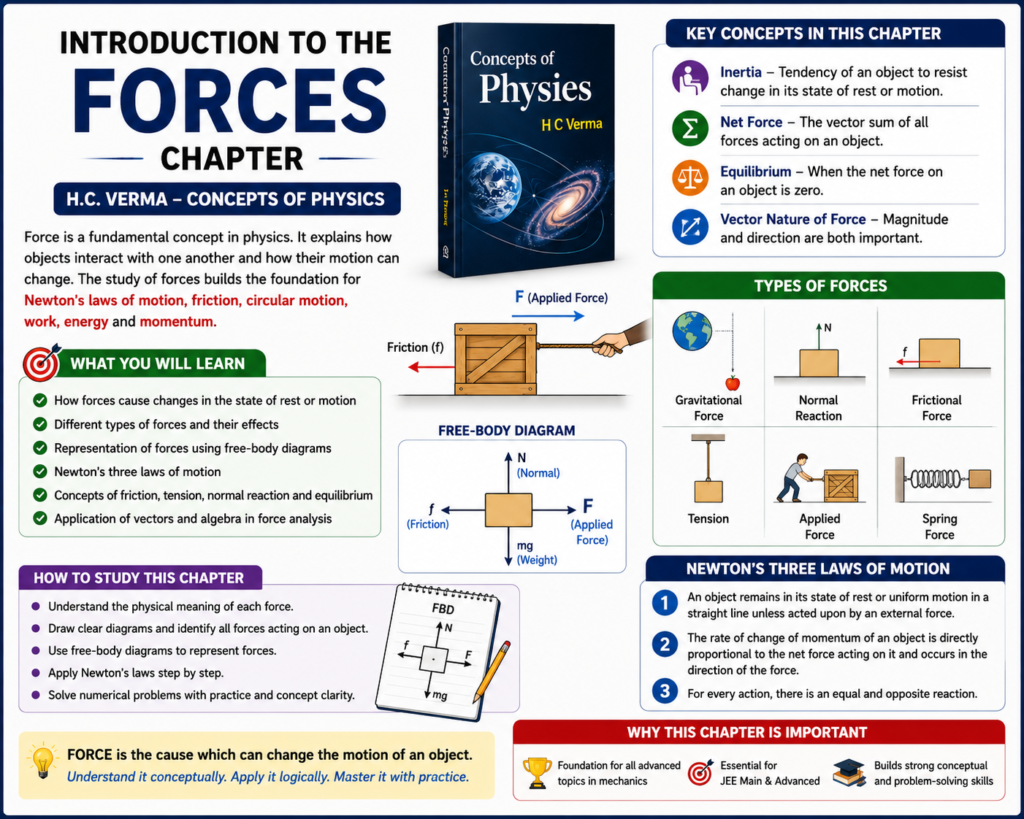
Force is one of the most fundamental concepts in physics. It explains how objects interact with one another and how their motion can change. In H.C. Verma’s Concepts of Physics, the study of forces builds an important foundation for understanding Newton’s laws of motion, friction, circular motion, work, energy and momentum.
The chapter encourages students to move beyond simply memorizing equations and instead understand the physical situations in which forces act. Students learn how to identify different forces, represent them using free-body diagrams, and apply Newton’s laws to solve problems.
Important ideas include inertia, net force, Newton’s three laws of motion, tension, normal reaction, friction and equilibrium. Mathematical tools such as vectors and algebra are also essential for analyzing forces in different directions.
A strong understanding of forces is particularly important for Class 11 Physics and NEET JEE preparation, because many advanced mechanics problems are built on these basic principles.
OBJECTIVE 1
1)When Neils Bohr shook hand with Werner Heisenberg,what kind of force they exerted ? a)Gravitational b)Electromagnetic c)Nuclear d)Weak
ANS) b Explanation Neil bohr explained about atomic model where as Werner Heisenberg explained about quantum mechanics energy in form of packets , when they shook hand it symbolizes the ideology related to electron proton nucleus etc which signifies electromagnetic force between particles .
2)Let E,G and N represent the magnitudes of electromagnetic ,gravitational and nuclear forces between two electrons at a given separation then a)N>E>G b)E>N>G c)G>N>E d)E>G>N
ANS) d Explanation between two electrons electromagnetic force is maximum , then gravitational force as it is the weakest force in nature at last nuclear force is not applicable between two electron so it does not affect so it comes last .
3) The sum of all electromagnetic forces between different particles of a system of charged particle is zero a)only if all the particles are positively charged b) only if all the particles are negatively charged c)only if half the particles are positively charged and half are negatively charged d) irrespective of the signs of the charges
ANS) d Explanation irrespective of the signs of the charges the sum of electromagnetic forces between different particle of a system of charged particle is zero . Due to action reaction pair sum of electromagnetic force leads to zero .
4)A 60 kg man pushes a 40kg man by a force of 60 N . The 40 kg man has pushed the other man with a force of a)40 N b) 0 c) 60 N d) 20 N
ANS) c Explanation Suppose 60 kg man pushes 40 kg man by a force of 60 N , then due to action reaction pair 40 kg man pushes the other man with the same force 60 N .
OBJECTIVE 2
1)A neutron exerts a force on a proton which is a) gravitational b) electromagnetic c) nuclear d)weak
Ans )a,c Explain as neutron carries mass and proton also carries mass so gravitational force is applicable , as neutron is neutral charge is zero but proton carries charge so electromagnetic force is not applicable , nuclear force is applicable as neutron strikes the proton,as nuclear force is applicable it is the strongest force so weak force is not applicable
2)A proton exerts a force on a proton which is a) gravitational b) electromagnetic c) nuclear d) weak
Ans)a,b,c Explain when proton exerts force on a proton gravitational force is applicable ,electromagnetic force is applicable , nuclear force is also applicable
3)Mark the correct statements a) the nuclear force between two protons is always greater than the electromagnetic force between them b)the electromagnetic force between two protons is always greater than the gravitational force between them c) the gravitational force between two protons may be greater than nuclear force between them d) electromagnetic force between two protons may be greater than the nuclear force acting between them
Ans)b,c.d Explain electromagnetic force is greater than gravitational force , nuclear force is strongest force when separation is less than 10 -14 metre so option b,c,d are correct
4)If all matter were made of electrically neutral particles such as neutrons a)there would be no force of friction b)there would be no tension in the string c)it would not be possible to sit on a chair d)the earth could not move around the sun
Ans) a,b,c Explain If all matter were made of electrically neutral then friction reduced to zero and tension force also reduced to zero but it would not affect gravitational force as it depends upon masses . Hence option a,b,c satisfies but d does not .
5)Which of the following systems may be adequately described by classical physics ? a)motion of a cricket ball b) motion of dust particle c)a hydrogen atom d)a neutron changing to a proton
Ans)a,b Explain for classical physics the interatomic separation is greater than 10 -6 m So motion of cricket ball , motion of dust particle satisfies the above condition but option c and d does not follow
6)The two ends of a spring are displaced along the length of the spring . All displacements have equal magnitudes . In which case or cases the tension or compression in the spring will have a maximum magnitude ? a)the right end is displaced towards right and the left end towards left b)both ends are displaced towards right c) both ends are displaced towards left d)the right end is displaced towards left and left end towards right
Ans)a,d Explain spring force = constant * displacement , option A spring force = constant * 2Y , option d spring force = constant * 2Y , but in case of option b and c spring force = constant * zero = zero . Hence option a and d are correct
7)Action and Reaction a)act on two different objects b)have equal magnitude c)have opposite directions d)have resultant zero
Ans)a,b,c,d Explain yes it satisfies all the mentioned options so all the options are correct
EXERCISE
1)The gravitational force acting on a particle of 1g due to a similar particle is equal to 6.67 *10 -17 N . calculate the separation between the particles ?
Ans)F = G m1 m2 /r 2 , r = √ G m1 m2 / F , r = √ (6.67 * 10 -11 * 10 -3 * 10 -3 /6.67 * 10 -17), r = 1 metre
2)Calculate the force with which you attract the earth ?
Ans) suppose a person mass is 60 kg , weight of person on the earth = m*g = 60 * 10 = 600 N Force on earth due to person = force on person due to earth = 600 N
3)At what distance should two charges equal to 1 c , be placed so that force between them equals your weight ?
Ans) let mass of person = 60 kg , weight = Force = 60 * 10 = 600 N
F= k0 q1 q2/ r2 , r = √ k0 q1 q2/F , r = √ 9 * 10 9 * 1 * 1 / 600 = √15 * 10 3 = 4 * 10 3 metre
4)Two spherical bodies each of mass 50 kg , are placed at a separation of 20 cm . Equal charges are placed on the bodies and it is found that the force of coulomb repulsion equals the gravitational attraction in magnitude . Find the magnitude of the charge placed on either body ?
Ans) F= G m1 m2 / r2 = k0 q1 q2 / r2 , q = √ G m1 m2 / k0 = √ 6.67 * 10 -11 * 50 * 50 /9 * 10 9 = 43 * 10 -10 coulomb = 4.3 * 10 -9 coulomb
5)A monkey is sitting on a tree limb. The limb exerts a normal force 0f 48 N and a frictional force 20 N . Find the magnitude of the total force exerted by the limb on the monkey ?
Ans) total force = √ 48 2 + 20 2 = 52 N
6)A body builder exerts a force of 150 N against a bullworker and compresses it by 20 cm . calculate the spring constant of the spring in the bullworker ?
Ans) Spring Force = K (spring constant) * Displacement , K = Spring Force / Displacement , K = 150/(20/100) = 150 * 5 = 750 N/m
7)A satellite is projected vertically upwards from an earth station . At what height above earth surface will the force on the satellite due to the earth be reduced to half its value at the earth station ?(radius of the earth is 6400 km )
Ans) gh = g(R2/(R+H)2), Fh = F (R2/(R+H)2), F/2 = F (R2/(R+H)2) , ½ = R2 /( R+H)2) , R+H = √2 R , H = 0.414 R
8)Two charged particles placed at a separation of 20cm exerts 20 N 0f coulomb force on each other . what will be force if the separation is increased to 25cm ?
Ans) F = K0 q1 q2 / R2 , q1 q2 = F R2/ K0 , q1 q2 = 20 * (20/100)2 / 9 * 10 9 = 0.08 ,
F = K0 q1 q2 / R 2 , F = 9 * 10 9 * 0.08 / (25/100)2 , F= 11.5 * 10 9 N
9)The force with which the earth attracts an object is called the weight of the object . Calculate the weight of the moon from the following data : The universal constant of gravitation G = 6.67 * 10 -11 N-m2/kg2 , mass of moon = 7.36 * 10 22 kg , mass of earth = 6 * 10 24 kg , distance between earth and moon 3.8*10 5 km .
Ans) F = W = G Mm * Me / R 2 , F = 6.67*10 -11 * 7.36 * 10 22 * 6 * 10 24 /(3.8*10 5)2 = 20.3 * 10 25 N
10)Find the ratio of the magnitude of the electric force to the gravitational force acting between two protons .
Ans)Fe = K0 q1 * q2/R2 = 9*10 9 * 1.6 * 10 -19 * 1.6 * 10 -19 / R 2 = 23.04 *10 -29 / R2
FG= G * mp * mp / R2 = 6.67 * 10 -11 * (1.67 * 10 – 27 )2/R 2 = 17.07 * 10 -65 / R2
Fe/FG = 1.34 * 10 36
11)The average separation between the proton and the electron in a hydrogen atom in ground state is 5.3*10 -11 m . a) Calculate the coulomb’s force between them at this separation b) when the atom goes into its first excited state the average separation between the proton and the electron increases to four times its value in the ground state . What is the coulomb force in this state ?
Ans) a) F = K0 q1 q2 / R2 , F = 9* 10 9 * 1.6 * 10 -19 * 1.6 * 10 -19 / (5.3 * 10 -11)2 , F = 23.04 * * 10 -27 / 28.09 * 10 -22 , F = 0.82 * 10 -5 N
b) F = K0 q1 q2 / R2 , F = 9* 10 9 * 1.6 * 10 -19 * 1.6 * 10 -19 / (4*5.3 * 10 -11)2 = 0.05 * 10 -5 N
12)The geostationary orbit of the earth is at a distance of about 36000km from the earth’s surface . Find the weight of a 120 kg equipment placed in a geostationary satellite . The radius of the earth is 6400km.
Ans)F = G Me * Meq / (R+h)2 , F = ( G Me/R 2 ) * R2 Meq/(R+h)2 , F = g * R 2 *Meq/ (R+h)2 , F = 9.8 * 6400 2 * 120 / (42400)2 = 26.46 N
Weight of a 120 kg equipment placed in a geostationary satellite = 24.46 N